Table of Contents
Introduction
How much weight do you really need before you descend on your next scuba dive?
For beginners, choosing dive weights can feel confusing and even stressful. How much weight do you need for scuba diving? The answer depends on more than your body weight alone. Your wetsuit, tank, equipment, and water type all affect your buoyancy.
Proper weighting helps you stay comfortable and maintain better buoyancy control underwater. It can also reduce unnecessary air consumption and make your dives feel easier. Improper weighting is one of the common mistakes instructors see during beginner training dives.
Entry-level scuba courses from agencies such as PADI and SSI teach divers how to check and adjust their weighting. You should never rely on another diver’s weight amount as your starting point.
In this guide, you’ll learn how to find your proper scuba diving weight. We’ll cover buoyancy tests, wetsuit thickness, tank types, and common weighting mistakes. By the end, you’ll understand how to fine-tune your weight safely for better control and confidence underwater.
For a more personalized starting estimate, try our scuba diving weight calculator before your next dive.
Why Proper Weighting Is So Important in Scuba Diving
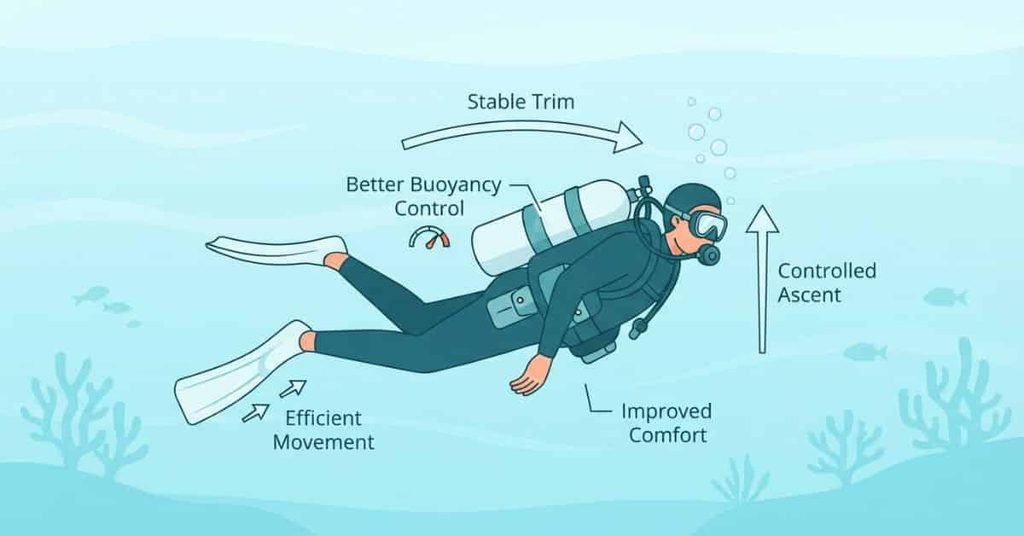
Proper weighting gives you better control over your buoyancy throughout the dive. The right amount of lead helps you stay neutral without constantly fighting to rise or sink.
Good buoyancy control also helps prevent unwanted depth changes. If you’re properly weighted, you can make small adjustments with your breathing and BCD. This makes hovering, descending, and ascending much easier.
Proper weighting can also help you manage your air supply more efficiently. When you carry too much lead, you may need more BCD air to stay neutral. That can increase drag and make you work harder underwater.
Your weighting also affects comfort and trim. Excess weight can pull your body downward and create poor horizontal positioning. Too little weight can make you struggle to descend or maintain your position during a safety stop.
Safety matters most when choosing your weight. Divers should never add extra lead simply to force themselves underwater. Instead, instructors teach controlled buoyancy checks to help determine an appropriate starting weight.
How Much Weight Will I Need to Scuba Dive?
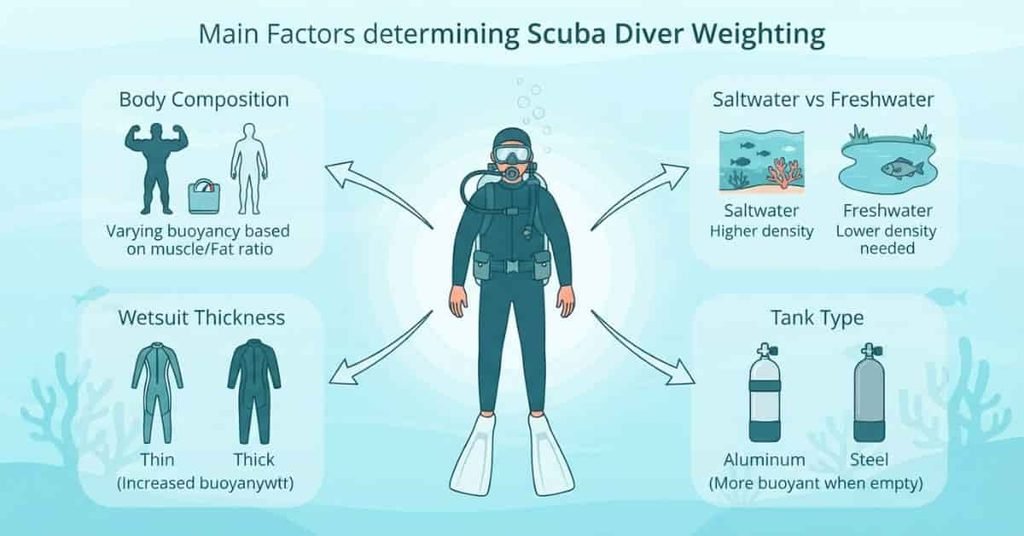
There’s no single weight formula that works for every scuba diver. Your correct amount depends on several factors that affect your overall buoyancy.
Your body composition, water type, exposure suit, tank, and other equipment can all change your weighting needs. Even two divers with identical body weights may require different amounts of lead.
The best approach involves testing your equipment in the water. Start with guidance from your instructor or divemaster, then perform a proper buoyancy check.
Remember that your required weight can also change when you switch equipment. A new wetsuit, different tank, or move from a lake to the ocean may require adjustment.
For beginners, the goal isn’t to carry the most weight possible. The goal is to use enough weight to descend comfortably while maintaining safe, controlled buoyancy throughout the dive.
Pro Tip
Use your actual diving setup when checking your weight. Changing one major piece of equipment can change your weighting needs.
Proper weighting can also improve buoyancy and efficiency, which is why learning how to reduce air consumption in scuba diving is useful for beginners.
Body Weight and Body Composition
Body weight gives you a starting point, but it doesn’t determine your exact scuba weighting needs. Two people weighing the same amount can have different buoyancy characteristics.
Body composition plays a role because fat and muscle have different densities. Muscle generally has greater density than body fat, while body fat tends to be more buoyant.
This means two divers with the same body weight may not need the same amount of lead. Their body composition can affect how much of their body naturally floats.
However, body composition isn’t the only factor. Your wetsuit, tank, BCD, fins, and other equipment also affect your overall buoyancy.
That’s why you shouldn’t copy the weight amount used by another diver. A friend who weighs the same as you may still need more or less lead.
Instead, use a controlled buoyancy check with your actual equipment. Your instructor can help you make small adjustments until you find a suitable starting weight.
The goal isn’t to calculate an exact number from your body weight. The goal is to achieve controlled, comfortable buoyancy with the equipment you’re actually using.
Pro Tip
Treat body weight as one factor, not a weighting formula. Always confirm your setup through an in-water buoyancy check.
Saltwater vs. Freshwater
The type of water you dive in can change how much weight you need. Saltwater contains dissolved minerals that make it denser than freshwater.
Denser water provides greater upward buoyant force on your body and equipment. As a result, many divers need more weight in the ocean than in a freshwater lake.
A diver who has a well-tested setup in a lake may need to adjust their weighting before diving in the ocean. The same principle applies when moving between different diving environments.
Your exposure suit and equipment still matter. Water type is only one part of the overall buoyancy equation.
You also shouldn’t assume that every saltwater dive requires the same weight. Different equipment configurations can change your needs.
For example, switching tanks or wearing a different wetsuit can affect your buoyancy. Always perform a buoyancy check when your diving setup changes significantly.
Pro Tip
If you regularly dive in both lakes and oceans, record your tested weight for each setup. This gives you a useful starting point for future dives.
Exposure Suit Thickness
Your exposure suit can have a major effect on your buoyancy. Thicker neoprene generally provides more buoyancy, especially when the suit is new and has not compressed much.
A thin 3mm wetsuit typically requires less compensating weight than a thicker 5mm or 7mm suit. The thicker the neoprene, the more buoyancy it can provide.
Wetsuits also compress as you descend. This reduces their thickness and buoyancy at depth. The effect becomes more noticeable with thicker exposure suits.
That’s one reason a diver’s weighting needs can change with different suits. A diver using a 3mm suit in warm water may need a different setup from someone wearing a 7mm suit in colder water.
Dry suits create additional considerations and require specific buoyancy and weighting techniques. Beginners should follow their instructor’s guidance when using unfamiliar exposure systems.
Always test your weighting with the suit you plan to wear. Don’t assume your weighting from one suit will work perfectly with another.
If you’re tracking how efficiently you use your tank, learn more about average air consumption in scuba diving and how SAC rates are measured.
Tank Type: Aluminum vs. Steel
Your scuba tank can also affect how much weight you need. Aluminum and steel tanks have different buoyancy characteristics, so switching between them can change your setup.
Aluminum tanks tend to become more positively buoyant as you use the gas inside. Near the end of a dive, an aluminum tank can provide more upward lift than it did earlier.
This change matters during the final part of a dive. You may notice it most clearly while completing a safety stop with a nearly depleted tank.
Steel tanks generally have different buoyancy characteristics and can often remain less buoyant throughout the dive. However, exact behavior varies by tank model and configuration.
Tank size also matters because larger tanks can carry more gas and have different weight and buoyancy characteristics. The same diver may therefore need different weighting with different tanks.
Before changing tank types, ask your instructor or dive professional about the tank’s buoyancy characteristics. Then perform a proper buoyancy check using the complete setup.
How Do I Know If I’m Properly Weighted?
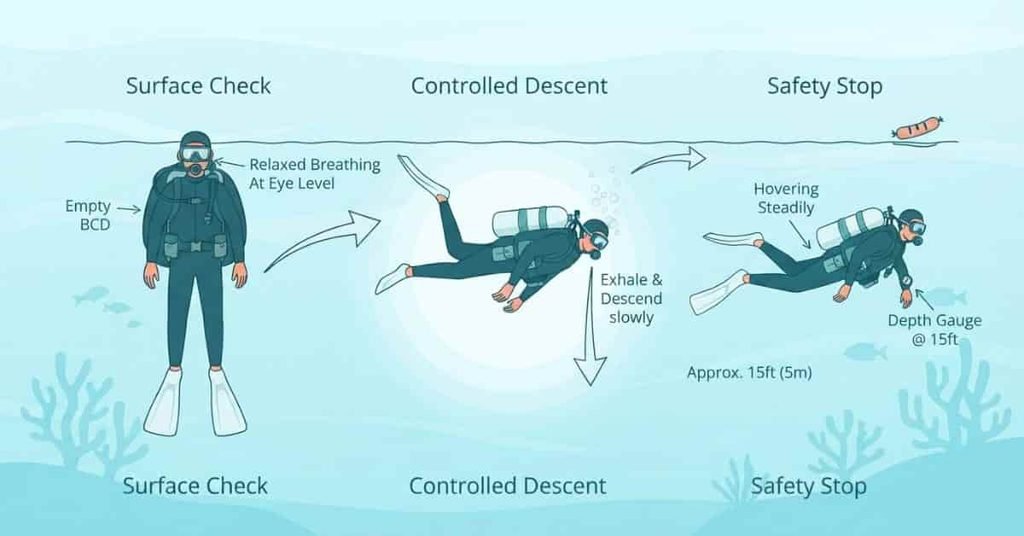
The best way to find your scuba diving weight is through an in-water buoyancy check. Your test should use the same equipment and exposure suit you plan to dive with.
Start with a full tank and an empty BCD. At the surface, relax and breathe normally. With your lungs comfortably filled, the water should sit around eye level when you’re properly weighted.
Don’t force yourself underwater by holding your breath or adding unnecessary lead. Your breathing naturally affects buoyancy, so stay relaxed during the test.
Your weighting should also work throughout the dive. As you use breathing gas, your tank becomes lighter, which can affect your buoyancy.
Surface Buoyancy Test (Step-by-Step)
A simple surface test can help you determine whether your starting weight is reasonable.
- Enter calm water with a full scuba tank.
- Wear your complete diving equipment.
- Fully deflate your BCD.
- Relax and breathe normally.
- With a normal breath, check your position at the surface.
- You should generally float around eye level.
- Exhale normally and observe how your body responds.
- Add or remove small amounts of weight if needed.
Descent Check
Your descent provides another useful clue about your weighting. After completing your surface check, move into a controlled descent with your dive buddy and follow your training procedures.
With proper weighting, you should be able to begin descending slowly after a normal exhalation. You shouldn’t need to force yourself downward with strong fin kicks.
If you cannot descend despite fully deflating your BCD, you may be underweighted. However, check your equipment and positioning before immediately adding lead.
Your exposure suit can also trap air and affect your descent. Relaxing your body and maintaining a suitable position can make the process easier.
Once you establish your starting weight, practice controlled descents during training. Your instructor can help determine whether your weighting or technique needs adjustment.
Safety Stop Check
The safety stop provides another opportunity to evaluate your weighting. Near the end of the dive, your tank contains less gas and may have different buoyancy characteristics.
At about 15 feet, divers should be able to maintain their depth without constantly adding or dumping BCD air. Your exact BCD use depends on your equipment and exposure suit.
If you struggle to stay down during the stop, you may need to review your weighting. Don’t simply add substantial lead without checking the rest of your setup.
A properly weighted diver should be able to make small buoyancy adjustments using breathing and BCD control. Your instructor can help you evaluate your position and make safe adjustments.
How Much Does a 200 lb Person Weigh Underwater?
A 200-pound person does not suddenly weigh zero underwater. Their mass stays the same, but water changes how heavy they feel through buoyancy.
This concept comes from Archimedes’ principle. In simple terms, water pushes upward on an object based on the amount of water that object displaces.
Your scuba gear, body, exposure suit, and trapped air all affect that upward force. That’s why two divers with the same body weight can need different amounts of lead.
A diver with more upward force than needed has positive buoyancy. They naturally move toward the surface. A diver with more downward force has negative buoyancy and tends to descend.
Neutral buoyancy means the upward and downward forces balance. The diver can hover at a chosen depth without constantly sinking or rising.
Your goal isn’t to make yourself as heavy as possible underwater. You want enough weight to achieve controlled, neutral buoyancy with your complete diving setup.
Signs You Are Overweighted
Carrying too much lead can make buoyancy control harder. Many beginners add extra weight when they struggle to descend, but this can create other problems.
One common sign is struggling to stay at the surface with an empty BCD. You may feel like you constantly need to add air to your BCD just to remain comfortable.
Too much weight can also contribute to poor trim. Your body may sit lower in the water, making it harder to maintain a streamlined position. This can increase drag and make swimming more tiring.
Overweighting may also contribute to higher air consumption. Carrying unnecessary lead can require more BCD inflation and effort to maintain your position.
Watch for these signs:
- You struggle to stay comfortably afloat at the surface.
- You constantly add air to your BCD.
- Your body position becomes difficult to control.
- You feel tired from unnecessary kicking and effort.
- Your air consumption seems higher than expected.
Don’t remove large amounts of weight based on one symptom. Check your equipment, breathing, trim, and buoyancy technique first.
Signs You Are Underweighted
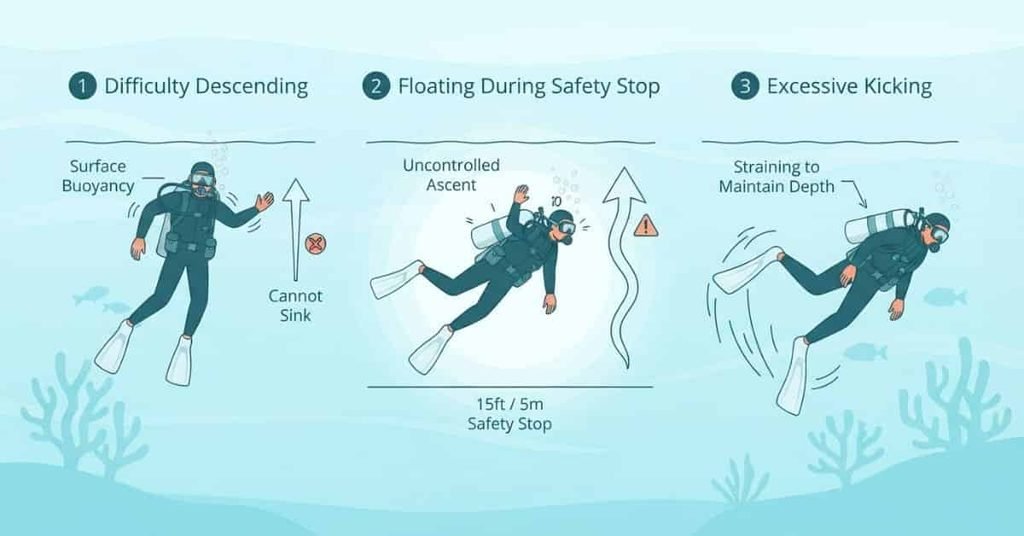
Being underweighted can make controlled diving difficult. You may struggle to descend even after fully deflating your BCD and relaxing your body.
One obvious sign is difficulty starting the descent. If you remain at the surface after a normal exhalation, your equipment or weighting may need evaluation.
Underweighting can also become noticeable during the safety stop. As you become lighter near the end of the dive, you may float upward instead of maintaining your planned depth.
Another sign is excessive kicking during descent. Constantly finning downward wastes energy and can increase your breathing effort.
However, these signs don’t always mean you need more lead. A trapped air pocket, incorrect BCD positioning, or poor technique can create similar problems.
Look for a consistent pattern rather than one isolated symptom. Your instructor can help determine whether weighting or technique causes the problem.
Common Beginner Weighting Mistakes
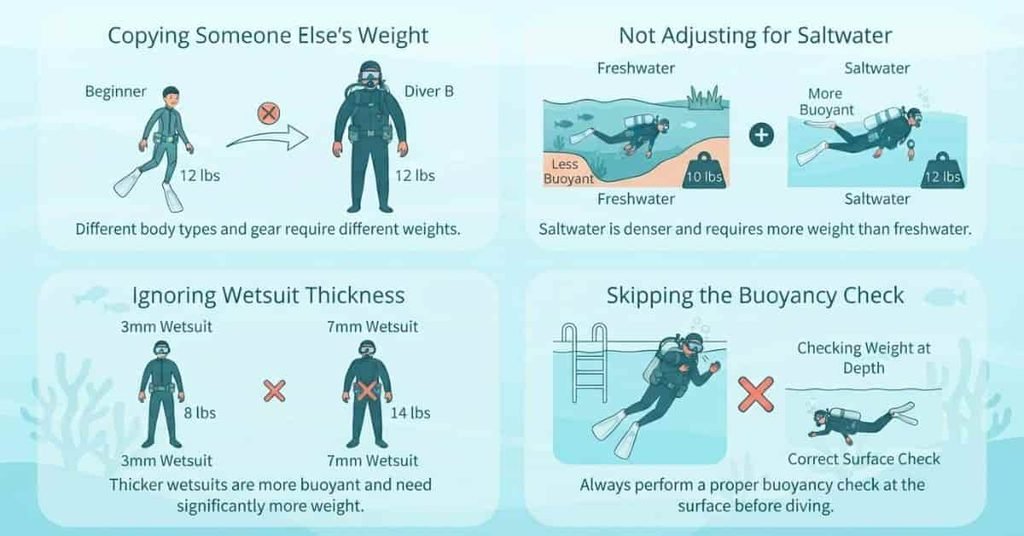
New divers often focus on finding a specific number of pounds. However, proper weighting depends on your body, equipment, water type, and exposure protection.
One common mistake is copying another diver’s weight. Even divers with similar body weights can have different buoyancy characteristics and equipment setups.
Another mistake is using the same weight in every environment. Saltwater generally provides more buoyancy than freshwater, so your weighting may need adjustment when changing locations.
Ignoring wetsuit thickness can also create problems. A thicker wetsuit usually provides more buoyancy than a thinner one, especially near the surface.
Some beginners also skip a proper buoyancy check. This leaves them guessing instead of testing their actual equipment configuration.
Avoid these common mistakes:
- Copying another diver’s weight.
- Using identical weighting in saltwater and freshwater.
- Ignoring wetsuit thickness.
- Adding lead without checking your technique.
- Skipping a proper buoyancy check.
- Making large weight changes at once.
Pro Tip
Keep a simple record of your tested weight for different tanks, suits, and diving environments. Use it as a starting reference, not a fixed rule.
How Instructors Help You Find the Right Weight
Scuba instructors don’t expect beginners to know their perfect weight immediately. They help you find a suitable starting point through practical buoyancy exercises.
During pool sessions, instructors can observe how your equipment behaves in controlled conditions. You can practice hovering, descending, and maintaining a stable position while making small adjustments.
The process usually works best through gradual adjustment. Your instructor may add or remove small amounts of weight, then repeat the buoyancy check.
Certification training also places strong emphasis on buoyancy skills. Organizations such as PADI and SSI teach beginners to develop controlled descents, ascents, hovering, and other essential diving skills.
These skills matter because proper buoyancy improves both comfort and control. Good weighting also helps you avoid relying on excessive finning or constant BCD adjustments.
Your instructor can also account for equipment changes. A different wetsuit, tank, or diving environment may require another buoyancy check.
Pro Tip
Tell your instructor whenever you change major equipment. A new wetsuit or tank can change your buoyancy and may require a small weight adjustment.
Conclusion
Finding the right scuba weight depends on more than your body weight. Your wetsuit, tank, water type, and equipment all affect buoyancy.
There is no universal formula for how much weight you need for scuba diving. A proper buoyancy check gives you a much better starting point than copying another diver.
The right weighting should help you descend smoothly, maintain neutral buoyancy, and stay comfortable during your safety stop. Avoid adding extra lead simply because you struggle with descent or trim.
If you’re new to diving, ask your instructor to help test your complete setup. Small adjustments can make a noticeable difference in comfort and control.
Have you found a weighting setup that works well for your dives? Share your experience below, or explore more beginner scuba guides on our website.
Frequently Asked Questions
There is no standard amount that works for every beginner. Your weight depends on body composition, wetsuit thickness, tank type, equipment, and water type. Start with guidance from your instructor and perform a proper buoyancy check. Avoid using another diver’s weight as your own starting point.
Not necessarily. Body weight alone doesn’t determine how much lead you need. Body composition, exposure suit, equipment, and natural buoyancy also matter. Two divers with similar body weights may need different amounts of weight. Your complete equipment setup and an in-water buoyancy check provide a better guide.
Some divers may need little or no additional lead, depending on their body composition and equipment. However, many divers need weights to achieve controlled neutral buoyancy. Don’t remove weights simply to reduce your equipment load. Your instructor can help determine whether you need additional weight.
Yes, changing tank size or type can affect your weighting. Different tanks have different buoyancy characteristics, and their buoyancy can change as you use the gas. Aluminum tanks can become more buoyant toward the end of a dive. Always recheck your buoyancy when switching tanks.
There is no reliable universal formula for determining your exact scuba weight. Rules based on body weight can provide rough starting estimates, but they don’t account for every equipment setup. A proper buoyancy check is more useful. Your instructor can help you fine-tune your weight safely.
Signs can include difficulty staying comfortable at the surface, excessive BCD inflation, poor trim, and increased effort underwater. Overweighting can make buoyancy control harder. Don’t remove large amounts of lead based on one symptom. Have an instructor check your complete setup and buoyancy.
You may be underweighted if you cannot descend despite fully deflating your BCD and relaxing your body. You might also float during a safety stop or rely heavily on finning downward. Check your technique and equipment first. If the problem continues, your instructor can help adjust your weighting.
Often, yes. Saltwater is denser than freshwater, so it provides greater buoyant force. A setup that works in a freshwater lake may require additional weight in the ocean. Your wetsuit, tank, and other equipment also affect the final amount. Always perform a buoyancy check after changing environments.
Generally, yes. Thicker neoprene provides more buoyancy than thinner neoprene, especially near the surface. A 7mm wetsuit may therefore require more weight than a 3mm suit. Wetsuits also compress during descent, changing their buoyancy. Test your weighting with the exact exposure suit you’ll use.
Check your weighting whenever your equipment or diving environment changes significantly. This includes changing wetsuits, tanks, BCDs, or moving between freshwater and saltwater. Even experienced divers benefit from occasional buoyancy checks. Your instructor or dive professional can help confirm your setup.
Use a controlled buoyancy check with your complete diving equipment. Start with a full tank, an empty BCD, and relaxed breathing. Then evaluate your surface position, descent, and safety-stop control. Make small adjustments rather than adding or removing large amounts of weight at once.

Scuba Diving Researcher & Beginner Guide
Evan Calder is the creator of DiveBeginner, a website dedicated to helping beginners learn scuba diving simply and practically 🌊
He focuses on scuba fundamentals, beginner safety, and clear diving guidance. Evan has studied ocean and marine science through programs at the Scripps Institution of Oceanography, UC San Diego, a globally recognized leader in ocean research.
Instead of complex technical language, Evan provides easy-to-follow, beginner-friendly guides based on real-world research, helping first-time divers feel confident before their first dive 🤿
DiveBeginner reflects his passion for making scuba diving accessible, safe, and enjoyable for everyone.