Table of Contents
Introduction
Have you ever surfaced from a dive and noticed your tank emptied faster than your buddy’s?
Learning how to reduce air consumption in scuba diving can make your dives more relaxed and enjoyable. Many beginners in the USA use air quickly during their first dives. Nervous breathing, poor buoyancy, and inefficient finning often play a role.
Using more air than an experienced diver is completely normal at first. Your body is still adapting to breathing underwater. You are also learning to control your buoyancy, trim, and movement.
The good news is that air consumption usually improves as your skills and comfort develop. You do not need to force yourself to take smaller breaths.
In this guide, you’ll learn practical ways to use less air while scuba diving. We’ll cover breathing, buoyancy, weighting, trim, fin technique, and gear streamlining. You’ll also learn how to track your air consumption and avoid common mistakes.
With consistent practice, you can become a calmer and more efficient diver.
Before trying to improve your gas usage, it helps to understand average air consumption in scuba diving and how your SAC rate compares.
What Is Air Consumption in Scuba Diving?
Air consumption in scuba diving refers to how quickly you use the breathing gas in your tank. Your tank pressure drops as you breathe during a dive. The faster that pressure falls, the more gas you are using.
Divers often compare air use by looking at starting tank pressure, ending pressure, and dive time. Depth also matters because water pressure increases as you descend. You use more gas per breath at greater depths than near the surface.
Air consumption varies widely between divers. Body size, experience, fitness, breathing habits, and diving conditions can all affect your gas use. Your comfort level also matters, especially when you are still learning.
Several factors can increase or decrease your air consumption:
- Breathing rate: Faster breathing usually uses more gas.
- Depth: Greater depth increases the amount of gas used with each breath.
- Buoyancy: Poor buoyancy can make you work harder.
- Swimming effort: Hard finning increases your body’s oxygen demand.
- Water temperature: Cold water can increase physical and breathing demands.
- Stress and comfort: Anxiety may cause faster or less controlled breathing.
- Equipment configuration: Draggy or poorly arranged gear can increase swimming effort.
Why Beginners Use Air Quickly
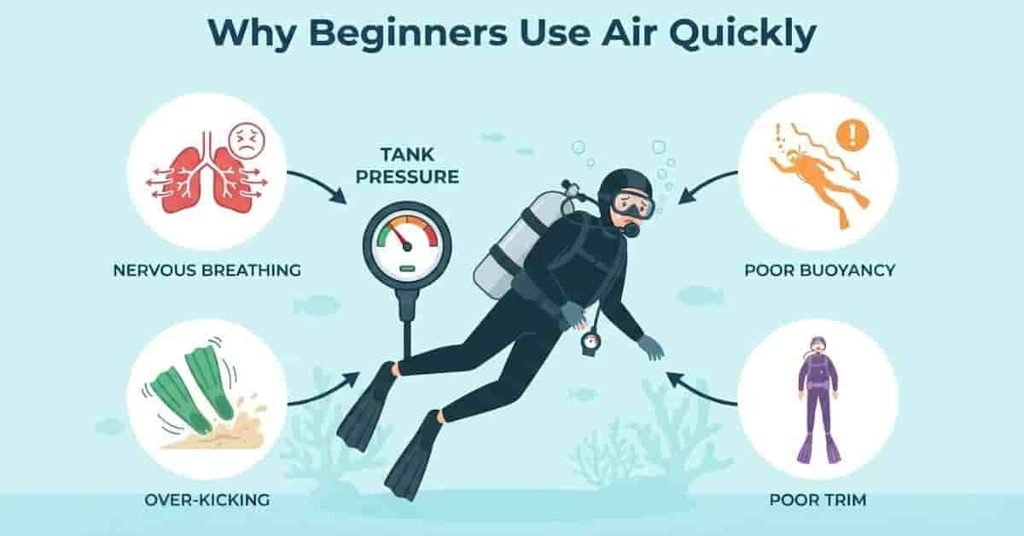
Many beginners use air faster because scuba diving requires new skills and constant awareness. Your body may respond to unfamiliar surroundings with faster breathing and extra movement.
You are also learning to control buoyancy, maintain trim, and move efficiently underwater. These skills can make a major difference in how much effort you use.
High air consumption often improves as you become more comfortable. The goal is not to breathe as little as possible. Instead, aim for calm breathing and efficient movement.
Proper weighting plays an important role in maintaining efficient buoyancy, so learn how much weight you need for scuba diving before adding extra weight.
Nervous or Rapid Breathing
Anxiety can make your breathing faster and less controlled underwater. New divers may feel tense during descent, navigation, or unexpected situations. That tension can increase breathing effort and make the tank pressure drop faster.
Take a moment to settle yourself before entering the water. Check your equipment and breathe normally while preparing for the descent.
Once underwater, focus on slow, relaxed movements. Keep your breathing natural rather than forcing very deep or shallow breaths. Never hold your breath to conserve gas.
Experience can also improve comfort. The more familiar you become with your equipment and surroundings, the easier it may feel to stay relaxed.
Pro Tip: Before descending, pause and take a few calm, normal breaths. Check your buoyancy and equipment before continuing.
Poor Buoyancy Control
Poor buoyancy can make you work harder throughout a dive. Beginners may add and release air from their BCD repeatedly while trying to maintain depth.
Every unnecessary adjustment can interrupt your balance and increase your workload. You may also kick more often to correct unwanted movement.
Good buoyancy allows you to stay at your desired depth with less effort. You can then focus on breathing, navigation, and enjoying the dive.
Practice small adjustments instead of making large BCD changes. Learn how your breathing affects your position in the water.
Pro Tip: Make gradual buoyancy adjustments and give your BCD time to respond before making another change.
Over-Kicking
Excessive fin movement can quickly increase your physical workload. Beginners sometimes kick harder when they feel unstable or want to move faster.
Harder kicking does not always mean better propulsion. Rapid or inefficient kicks can waste energy and increase your breathing demand.
Try using slow, controlled fin movements instead. Keep your body relaxed and let your fins provide steady propulsion.
Avoid kicking when you do not need to move. Good buoyancy and trim can help you maintain position without constant fin movement.
Different fin techniques can work well in different situations. Your instructor can help you practice an efficient kick that suits your equipment and diving environment.
Pro Tip: Reduce your kick effort and focus on smooth, controlled movements rather than speed.
Poor Trim
Trim describes your body’s position in the water. A horizontal position can help reduce drag while you swim.
Poor trim may leave your legs lower than your upper body. This position increases resistance and can make swimming harder.
You may then kick more strongly to maintain movement. That extra effort can increase your breathing rate and air consumption.
Good trim keeps your body balanced and helps you move through the water more efficiently. Your equipment setup and weighting can both affect your position.
Practice maintaining a relaxed, streamlined posture. Keep unnecessary equipment secured and avoid letting hoses or accessories create extra drag.
Pro Tip: Ask an instructor or experienced diver to check your underwater trim. Small equipment adjustments can sometimes improve your position.
Cold Water and Physical Effort
Cold water can affect how comfortable and relaxed you feel underwater. Without suitable exposure protection, you may become distracted by the cold.
Cold conditions can also make diving physically demanding. Shivering and increased effort can affect your breathing and overall comfort.
Choose exposure protection that suits the water temperature and planned dive. Staying comfortable can help you focus on calm breathing and efficient movement.
Physical effort matters in warm water too. Strong currents, long surface swims, heavy equipment, or difficult entries can increase your workload.
Plan your dive around the conditions and avoid unnecessary exertion. Swim at a controlled pace and use your buoyancy skills whenever possible.
Pro Tip: Stay warm, pace yourself, and avoid unnecessary effort before and during the dive.
10 Practical Ways to Reduce Air Consumption
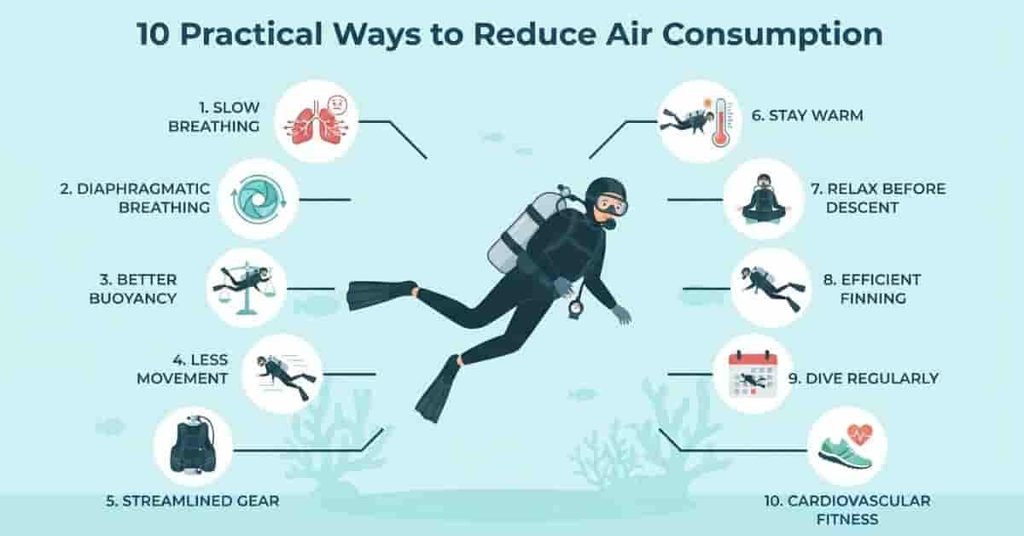
Reducing air consumption starts with becoming calmer and more efficient underwater. You do not need to force your breathing or copy another diver’s air use.
Focus on skills that reduce unnecessary effort. Better breathing habits, buoyancy, trim, finning, and fitness can all support more efficient diving.
1. Slow Down Your Breathing
Calm, controlled breathing can help you avoid unnecessary air use. Beginners often breathe faster when they feel nervous or work harder underwater.
Aim for relaxed, natural breaths instead of trying to take extremely deep breaths. Forced deep breathing can make you feel uncomfortable and may not improve your efficiency.
Never hold your breath to save air. Continue breathing normally throughout the dive while following your training and instructor’s guidance.
Pro Tip: Notice your breathing when you feel stressed. Relax your body and return to a comfortable, natural breathing rhythm.
2. Practice Diaphragmatic Breathing
Diaphragmatic breathing uses the diaphragm more effectively during normal breathing. You may notice your abdomen moving gently as you breathe.
Practice this technique on land before using it during a dive. Lie or sit comfortably and breathe naturally without forcing each breath.
The goal is not to take fewer breaths at all costs. Instead, focus on relaxed breathing that does not involve unnecessary tension in your chest, shoulders, or neck.
Once the technique feels comfortable, you can become more aware of your breathing underwater. This awareness may help you stay calmer during the dive.
Pro Tip: Practice relaxed diaphragmatic breathing for a few minutes during your normal daily routine.
3. Improve Your Buoyancy Control
Neutral buoyancy helps you stay at your desired depth without constant effort. Poor buoyancy can cause unnecessary kicking and repeated BCD adjustments.
Make small, controlled BCD changes instead of adding large amounts of air. Then give the BCD time to respond before making another adjustment.
Your breathing also affects buoyancy. A calm breathing pattern can help you make smaller depth corrections.
Good buoyancy takes practice. Work on it during training dives and ask an instructor for feedback when needed.
Pro Tip: Practice hovering calmly while keeping your body relaxed and your movements minimal.
4. Reduce Unnecessary Movement
Every unnecessary movement can add physical effort during a dive. Beginners may use their hands or arms when they could remain still.
Keep your hands relaxed whenever possible. Avoid waving your arms, sculling constantly, or making sudden body movements.
Let your buoyancy, trim, and fin technique handle most of your movement. A stable body position can make swimming feel much easier.
You should still use your hands when a situation requires them. The goal is efficient movement, not staying completely motionless.
Pro Tip: During your next easy swim, notice how often you move your hands without actually needing them.
5. Streamline Your Gear
Dangling equipment can increase drag as you move through the water. Extra resistance may require more kicking and physical effort.
Secure hoses, gauges, clips, and accessories close to your body. Keep necessary equipment accessible without allowing it to hang loosely.
A streamlined setup can make your underwater profile smoother. It can also reduce the effort needed to maintain a steady swimming pace.
Do not remove or reposition essential safety equipment without understanding its purpose. Ask a qualified dive professional if you are unsure about your configuration.
Pro Tip: Before entering the water, check that your hoses and accessories are secure and streamlined.
6. Stay Warm
Cold water can make diving less comfortable and increase physical demands. Shivering can also make it harder to stay relaxed.
Choose exposure protection that matches the water temperature and your planned dive. A properly fitting wetsuit or other suitable protection can improve comfort.
Staying warm does not guarantee lower air consumption. However, avoiding unnecessary cold stress can help you remain comfortable and focused.
Remember that water temperature can change during a dive. Plan your exposure protection based on the actual conditions.
Pro Tip: Check local water conditions before diving and choose exposure protection appropriate for the planned dive.
7. Relax Before Descent
The first few minutes of a dive can feel stressful for beginners. Rushing into the descent may lead to faster breathing and unnecessary movement.
Take a moment to settle yourself before descending. Check your equipment, breathing, buoyancy, and surroundings.
Start the descent calmly and avoid trying to reach the bottom as quickly as possible. Controlled movement can help you establish a comfortable rhythm.
If you feel unusually stressed, communicate with your buddy and address the problem. Good diving means managing your comfort as well as your gas supply.
Pro Tip: Pause before descent, check your breathing, and begin only when you feel prepared.
8. Improve Your Fin Technique
Efficient finning can help you move with less wasted effort. Fast, short kicks may create unnecessary movement without providing efficient propulsion.
Use slow, controlled kicks and maintain a relaxed body position. The right technique depends on your equipment, environment, and diving conditions.
A frog kick can be useful in some situations, especially when you want controlled propulsion near the bottom. Learn it from a qualified instructor before using it in challenging environments.
Avoid kicking when you can simply glide or maintain position. Your buoyancy and trim should support efficient movement.
Pro Tip: Practice controlled fin movements in a safe training environment before using new techniques during demanding dives.
9. Dive Regularly
Regular diving can help you become more comfortable with your equipment and underwater environment. Familiarity may make it easier to stay relaxed and move efficiently.
You can also use repeated dives to improve buoyancy, trim, breathing awareness, and fin technique. Small improvements often become easier to notice over time.
If you have not dived recently, consider a refresher session. A qualified instructor can help you review essential skills before returning to more demanding dives.
Focus on skill development instead of competing with other divers. Everyone has different physical characteristics, experience, equipment, and diving conditions.
Pro Tip: Keep practicing your core skills during easy, controlled dives before adding more challenging conditions.
10. Build General Cardiovascular Fitness
Good cardiovascular fitness can support your ability to swim efficiently underwater. Better overall conditioning may also help you handle physical effort more comfortably.
Activities such as walking, cycling, swimming, or other aerobic exercise can support general fitness. Choose activities that fit your current ability and health needs.
Fitness alone will not automatically transform your air consumption. Your breathing habits, buoyancy, trim, equipment, and diving conditions still matter.
Avoid starting intense exercise solely to reduce tank consumption. Build fitness gradually and choose activities you can maintain consistently.
Pro Tip: Combine regular aerobic activity with scuba skills practice for a balanced approach to becoming a more efficient diver.
You can also use our scuba air consumption calculator to estimate your gas consumption from your own dive data.
How Proper Weighting Helps Reduce Air Usage
Proper weighting plays an important role in buoyancy control and diving efficiency. The right amount of weight helps you maintain neutral buoyancy without constant corrections.
Carrying too much weight can create extra work. An overweighted diver may need more air in the BCD to become neutrally buoyant.
Adding more BCD gas can increase your buoyancy changes as you move through the water. Even small depth changes can affect the gas volume inside the BCD.
This can make buoyancy control feel less predictable, especially for beginners. You may find yourself adding and releasing air more often to maintain your depth.
Correct weighting can make these adjustments easier. It can also help you maintain a stable position without relying heavily on your BCD.
However, never remove weight simply because you want to use less air. Your weighting must support safe buoyancy control throughout the dive.
If you are unsure about your weighting, ask a qualified instructor or dive professional to check it with you. A proper weighting check should consider your equipment, exposure protection, tank, and diving conditions.
How Buoyancy and Trim Affect Air Consumption
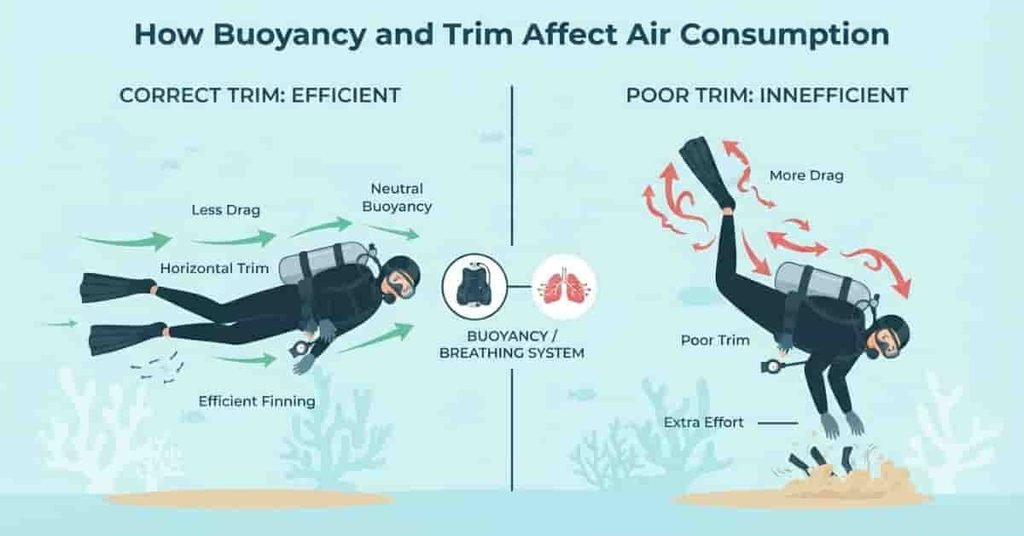
Neutral buoyancy is one of the most important efficiency skills in scuba diving. It allows you to stay at your desired depth without constantly kicking or adjusting your BCD.
When your buoyancy is balanced, you can move through the water with less unnecessary effort. This can help you maintain a calmer breathing pattern during the dive.
Trim also affects how efficiently you move. A horizontal body position can reduce drag because less of your body and equipment pushes against the water.
Poor trim can leave your legs lower than your upper body. You may then need stronger fin kicks to maintain forward movement.
Constant depth changes can create another problem. Every unnecessary ascent or descent may require extra finning and buoyancy adjustments.
Breathing, buoyancy, trim, and finning work together as one system. Calm breathing supports stable buoyancy, while good trim makes each fin kick more effective.
For beginners, keep the goal simple: move slowly, stay balanced, and make small adjustments. Avoid chasing perfect control immediately. These skills improve through practice.
Does Tank Size Affect Air Consumption?
A larger scuba tank does not make you breathe more efficiently. It simply holds more breathing gas than a smaller tank.
Your tank capacity describes how much gas the cylinder can hold. Tank pressure tells you how much gas remains available at a particular point in the dive.
Your personal breathing rate is different. It describes how quickly your body uses breathing gas. Your actual air consumption depends on your breathing, depth, activity level, and diving conditions.
For example, switching to a larger tank may give you more available gas. It does not automatically reduce the amount of gas your body uses during each minute underwater.
Tank choice should match the dive rather than simply your desire to carry more gas. Consider the planned depth, duration, required gas supply, equipment configuration, and local diving practices.
A larger cylinder may also add weight or change your equipment setup. Those changes can affect how comfortable and streamlined you feel underwater.
If you use air faster than your buddy, do not assume you need a larger tank immediately. Work on breathing, buoyancy, trim, and efficient movement first.
How to Track Your Air Consumption
Tracking your air use helps you see whether your diving efficiency improves over time. It also gives you useful information for future dive planning.
After each dive, record a few basic details in your logbook. These details help you compare your gas use under similar conditions.
Record:
- Starting tank pressure
- Ending tank pressure
- Total dive time
- Maximum or average depth
- Tank size
- Water temperature
You can also note current, equipment changes, stress, and unusual physical effort. These factors can explain why one dive used more gas than another.
Try comparing dives with similar depths and conditions. A shallow, calm-water dive may not provide a fair comparison with a deeper dive in cold water or strong current.
You may also hear divers discuss SAC rate, which means Surface Air Consumption rate. It estimates how much gas you would use per unit of time at the surface.
SAC can provide a more useful comparison than simply looking at tank pressure. Your dive professional can show you how to calculate and interpret it correctly.
Most importantly, watch your personal trend. Your goal is not to beat another diver’s air consumption.
How Long Does It Take to Improve Air Consumption?
There is no single timeline for improving air consumption. Every diver develops comfort, breathing control, and underwater skills at a different pace.
Some beginners may notice improvement after several comfortable dives. Others may need more practice before their air use becomes more consistent.
Your progress can depend on several factors:
- Experience: More diving can improve familiarity and confidence.
- Comfort underwater: Reduced stress can support calmer breathing.
- Buoyancy skills: Better control reduces unnecessary effort.
- Fitness: General conditioning can support efficient swimming.
- Water temperature: Cold conditions may increase physical demands.
- Dive frequency: Regular practice can reinforce good habits.
- Stress level: Anxiety can affect breathing and movement.
Do not expect every dive to show improvement. Conditions can change, and those changes can affect your gas use.
Instead, track your air consumption across multiple dives. Compare dives with similar depths, temperatures, equipment, and activity levels when possible.
Avoid trying to achieve a specific breathing rate. Your goal should be comfortable, natural breathing and efficient diving skills.
Common Mistakes That Waste Air
Small habits can increase your air consumption without you noticing. Beginners often waste gas through extra movement, stress, or frequent buoyancy corrections.
The good news is that most of these habits can improve with practice. Focus on calm breathing, efficient movement, and good buoyancy control.
Breathing Too Fast
Rapid breathing can increase how quickly you use your tank gas. Stress, excitement, cold water, or physical effort can all affect your breathing pattern.
Avoid trying to force extremely slow breathing. Instead, aim for calm, natural breaths that feel comfortable.
If you notice your breathing becoming faster, reduce unnecessary movement and check your comfort. Never hold your breath to conserve air.
Holding Your Breath
Holding your breath is not a safe way to save tank gas. Divers should maintain continuous, normal breathing throughout the dive.
Breath-holding can create serious risks during changes in depth. Follow your scuba training and keep breathing normally.
If you feel short of breath, stop unnecessary activity and communicate with your buddy when appropriate.
Overusing the BCD
Frequent large BCD adjustments can make buoyancy harder to control. Beginners may add too much air, then release it repeatedly.
This can create unnecessary depth changes and extra work. It can also make it harder to develop a stable sense of neutral buoyancy.
Practice making small adjustments and allow time for the BCD to respond. Proper weighting and trim can also make buoyancy easier to manage.
Kicking Too Hard
Strong, rapid finning can increase physical effort and breathing demand. Beginners sometimes kick harder when they feel unstable or want to move faster.
Instead, use smooth and controlled fin movements. Let your buoyancy and trim support your position.
Efficient propulsion should feel controlled rather than rushed. Practice different fin techniques with an instructor in suitable conditions.
Constantly Changing Depth
Unnecessary depth changes can increase your workload. Each change may require additional finning and buoyancy adjustments.
Try to maintain a steady depth when the dive plan allows it. Use small corrections rather than repeatedly moving up and down.
Good buoyancy control can make maintaining depth much easier.
Trying to Match Another Diver’s Air Consumption
Every diver has different physiology, experience, fitness, equipment, and diving conditions. Comparing tank pressure directly can therefore be misleading.
Your buddy may naturally use less gas than you. That does not mean you should change your breathing or take unnecessary risks.
Plan your gas supply around your own needs and the dive requirements. Safe gas management matters more than matching another diver’s consumption.
Rushing the Dive
Rushing during descent, navigation, or ascent can increase stress and physical effort. Stress may also affect your breathing and movement.
Give yourself enough time to complete each part of the dive calmly. If something feels wrong, communicate with your buddy and address the issue.
A controlled pace helps you stay aware of your surroundings, equipment, and gas supply.
When Should You Be Concerned About High Air Consumption?
Higher air consumption is not automatically a safety problem. Beginners often use more gas while developing comfort, buoyancy, trim, and efficient movement.
However, unusually high consumption that continues despite improving skills deserves attention. Discuss your air use with a qualified instructor or dive professional if you remain concerned.
A sudden change from your normal air consumption also deserves attention. Consider whether the dive involved unusual stress, cold water, current, strenuous swimming, equipment changes, or another factor.
Always follow basic gas-management habits:
- Monitor your tank pressure regularly.
- Follow your planned depth and dive limits.
- Maintain an appropriate gas reserve.
- Communicate clearly with your buddy.
- End the dive according to your training and gas plan.
Do not try to solve high air consumption by holding your breath or ignoring your pressure gauge. Those approaches can create unnecessary risks.
Your goal should be safe and efficient diving. Air conservation matters, but saving air should never come before safe diving practices.
Conclusion
Learning how to reduce air consumption in scuba diving takes practice, patience, and better underwater habits. You do not need to force yourself to breathe less or compete with your buddy.
Focus on calm breathing, neutral buoyancy, proper weighting, good trim, and efficient finning. Streamlining your gear and staying comfortable can also reduce unnecessary physical effort.
Track your tank pressure, dive time, depth, and conditions after each dive. This helps you spot gradual changes in your air consumption and understand what affects your gas use.
Remember that every diver has different needs and natural air consumption. Your goal should be safe, relaxed, and efficient diving.
With regular practice, you can become more comfortable underwater and improve your overall efficiency. Work on your skills first, and let better air consumption develop naturally over time.

Scuba Diving Researcher & Beginner Guide
Evan Calder is the creator of DiveBeginner, a website dedicated to helping beginners learn scuba diving simply and practically 🌊
He focuses on scuba fundamentals, beginner safety, and clear diving guidance. Evan has studied ocean and marine science through programs at the Scripps Institution of Oceanography, UC San Diego, a globally recognized leader in ocean research.
Instead of complex technical language, Evan provides easy-to-follow, beginner-friendly guides based on real-world research, helping first-time divers feel confident before their first dive 🤿
DiveBeginner reflects his passion for making scuba diving accessible, safe, and enjoyable for everyone.