Table of Contents
Introduction
Have you ever wondered how long you could actually breathe underwater during a scuba dive?
Knowing how long you can stay underwater scuba diving helps you plan safer and more enjoyable dives. For beginners in the USA, dive time can seem confusing because several factors work together.
Your tank size matters, but it isn’t the only limit. Your breathing rate, dive depth, air supply, and no-decompression limits can all affect your time underwater. Your training and dive plan also play an important role.
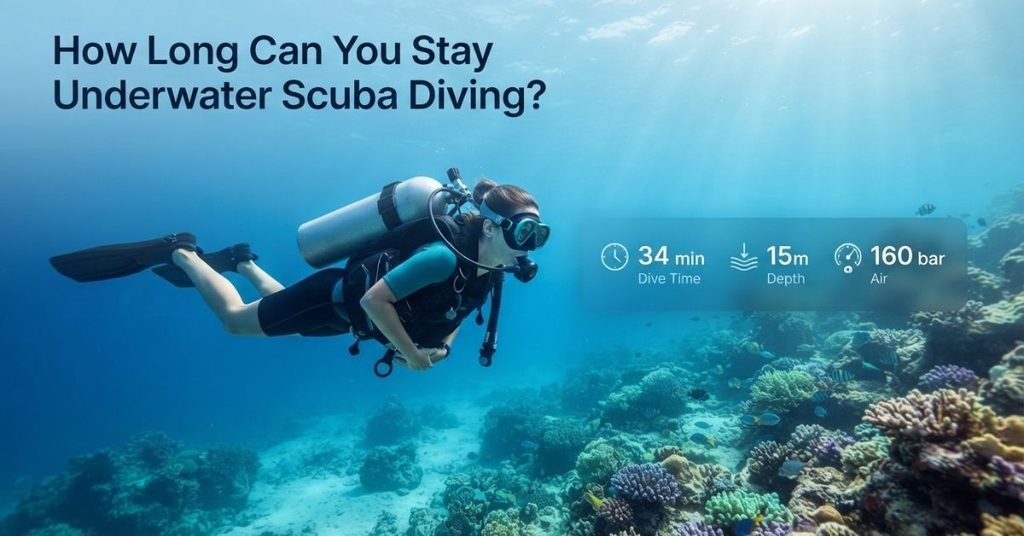
Most recreational scuba dives last around 30 to 60 minutes. However, your actual dive time can vary based on your experience and conditions.
In this guide, you’ll learn what controls scuba dive time and why some divers stay underwater longer. You’ll also understand how air consumption, depth, tank pressure, and safety limits affect each dive.
By the end, you’ll have a clear idea of how to estimate your underwater time and plan your dives more confidently.
While planning your dive time, you may also wonder whether you can talk underwater while scuba diving and how divers communicate with their buddies.
What Determines How Long You Can Stay Underwater?
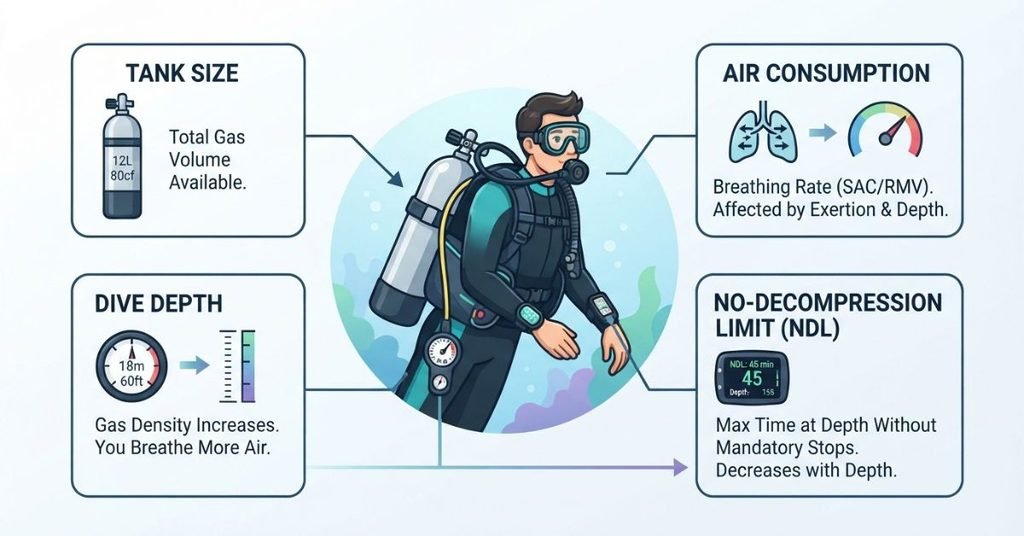
Your scuba dive time depends on more than the amount of air inside your tank. Tank size, breathing rate, depth, and decompression limits all affect how long you can safely remain underwater. Understanding these factors helps beginners plan dives with realistic expectations.
1. Tank Size
A standard aluminum 80 tank is common in recreational scuba diving. The “80” refers to its approximate capacity of 80 cubic feet of gas when filled to its rated pressure. However, a larger tank does not automatically give you unlimited dive time.
Your actual bottom time depends heavily on how quickly you breathe. A diver with efficient breathing may use the same tank more slowly than a new diver. Tank pressure, depth, and your personal air consumption also affect the usable supply.
For beginners, it’s better to think of tank size as one part of your available air supply. You still need to monitor your pressure throughout the dive and follow your planned reserve.
Pro Tip: Choose tank size based on your dive plan, equipment needs, and training guidance. Never treat extra tank capacity as permission to extend a dive beyond safe limits.
2. Your Air Consumption Rate
Your air consumption rate can strongly affect how long you stay underwater. Beginners often use air faster because they may breathe harder or feel less relaxed underwater. As you gain experience, better buoyancy control and calmer breathing can improve efficiency.
Your breathing rate can also change during exercise, stress, cold water, or strong currents. That means two divers using identical tanks may have very different dive times.
For a deeper explanation, see our [internal link: scuba air consumption guide]. It can help you understand how breathing habits affect your available air and overall dive planning.
Expert Tip: Focus on staying relaxed and maintaining good buoyancy. Never hold your breath to conserve air while scuba diving.
3. Depth of the Dive
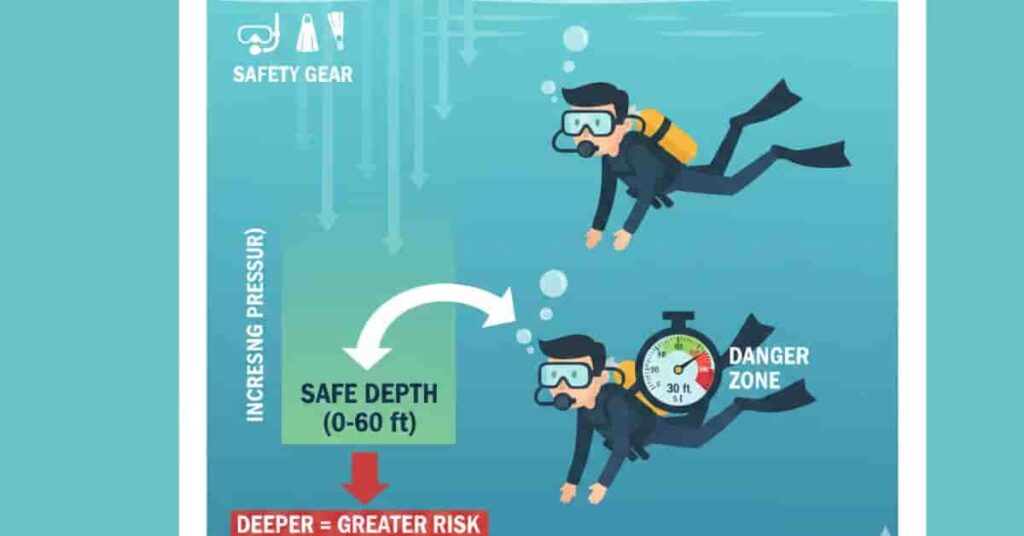
Depth is one of the most important factors affecting scuba dive time. As you descend, the surrounding water pressure increases. Your regulator delivers gas at that higher pressure, so each breath uses more gas from the tank.
For example, breathing at greater depth consumes tank gas faster than breathing at the surface. This means the same tank can support less time at deeper depths.
Depth also affects your no-decompression limit (NDL). Deeper dives generally give you less time before you reach the limit for a no-decompression dive.
You don’t need advanced physics to understand the basic idea. Greater depth means higher pressure, which means more gas is used with each breath.
4. No-Decompression Limits (NDL)
Your tank isn’t the only thing that limits your dive time. You also need to consider your no-decompression limit, or NDL.
The NDL is the maximum planned time you can spend at a particular depth without requiring mandatory decompression stops during your ascent. Your NDL changes with depth and other factors.
Modern dive computers track depth and time to help divers monitor their remaining no-decompression time. They provide important information during the dive, but they don’t replace proper training or good judgment.
Safety Tip: Treat your NDL as a planning limit, not a target to reach. Always follow your training, dive plan, and computer guidance.
Average Scuba Dive Duration for Beginners
For most beginners, a recreational scuba dive often lasts around 30–45 minutes. Your actual dive time depends on your air consumption, depth, tank size, and dive plan.
A 60-minute dive can be possible in shallow water when conditions are favorable. However, your available air isn’t the only factor. Your no-decompression limit, reserve pressure, and training requirements also affect the planned duration.
Instructors usually plan conservative dives for beginners. New divers may breathe faster while learning buoyancy control and staying comfortable underwater. Currents, cold water, workload, and stress can also increase air use.
Expert Tip: Don’t try to maximize every minute of your tank. A shorter, well-planned dive with enough reserve is safer than stretching your available air.
How Long Can You Stay Underwater at Different Depths?
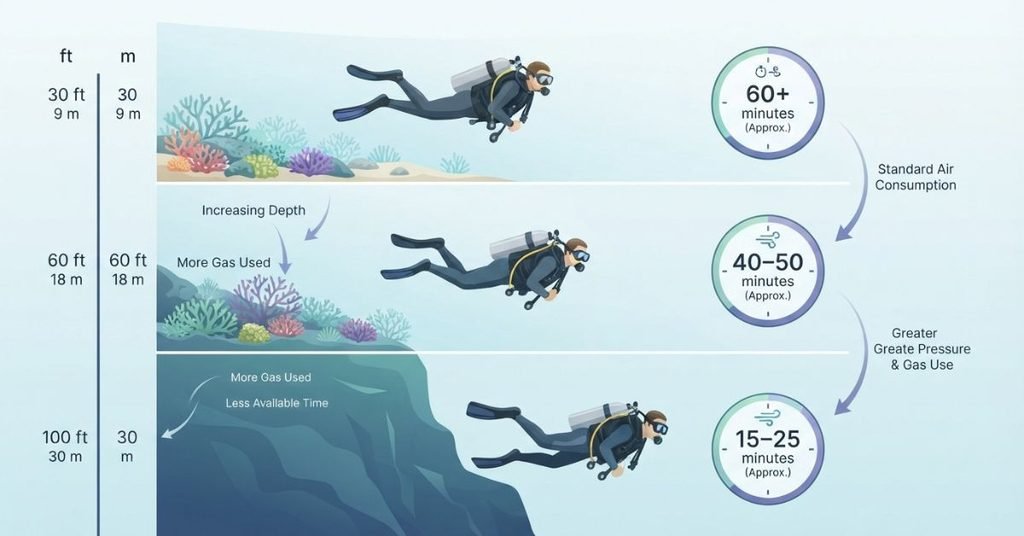
Depth has a major effect on both air consumption and available no-decompression time. As you descend, increasing pressure causes you to use more gas with each breath.
Regardless of how long your dive lasts, learning scuba diving hand signals is essential because they let you communicate clearly without speaking.
The table below gives approximate recreational dive-time examples for beginners. Actual limits can vary based on your dive computer, breathing rate, tank, gas supply, and training.
| Depth | Typical Maximum Time |
|---|---|
| 30 ft (9 m) | 60+ minutes |
| 60 ft (18 m) | 40–50 minutes |
| 100 ft (30 m) | 15–25 minutes |
These figures are general examples, not fixed safety limits. Your available air and no-decompression limit may produce different results.
At 30 feet, a diver may have more available time because gas consumption and pressure exposure remain relatively lower. At greater depths, both factors become more restrictive.
Pro Tip: Always plan your dive using your training, dive computer, gas supply, and appropriate safety margins. Never use a table like this as permission to exceed your actual limits.
What Is the Longest Time Spent Underwater With Scuba?
The longest underwater stays can sound impressive, but they don’t represent normal recreational scuba diving. Recreational dives follow strict limits for depth, gas supply, decompression exposure, and diver safety.
Some endurance records use surface-supplied breathing systems or highly controlled conditions. These systems can provide breathing gas from outside the water instead of relying only on a standard scuba cylinder.
Specialized divers may also use technical equipment and carefully managed decompression procedures. These dives require advanced training, planning, support teams, and equipment.
A world record should never be treated as a target for recreational divers. Beginners should follow their certification limits and use their dive computer correctly.
Can You Stay Underwater for Hours?
Yes, people can remain underwater for hours with specialized systems and appropriate support. However, this is very different from a typical recreational scuba dive.
If you’re curious about communication beyond hand signals, learn more about whether you can talk underwater while scuba diving and what makes underwater speech difficult.
Technical and commercial divers may use surface-supplied breathing systems, specialized gas mixtures, or other equipment. These systems support underwater operations that can last much longer than ordinary recreational dives.
Beginners should not attempt prolonged underwater stays. Longer dives can involve greater gas requirements, decompression considerations, environmental hazards, and equipment demands.
Proper safety training becomes increasingly important as dive complexity increases. Divers must understand their equipment, gas management, decompression requirements, and emergency procedures before attempting advanced dives.
What Happens If You Stay Too Long?
Staying underwater longer than your plan can create several avoidable problems. The risks depend on your depth, gas supply, dive profile, and training.
One concern is decompression sickness, which can occur when dissolved gases form harmful bubbles during or after ascent. Staying deeper or longer can increase your decompression exposure.
Running low on breathing gas is another important concern. If you use more air than expected, you may reach your reserve sooner than planned. Always monitor your tank pressure throughout the dive.
Long dives can also cause fatigue, especially in cold water or challenging conditions. Tiredness can affect your comfort, awareness, and ability to respond calmly.
These risks don’t mean you should fear longer dives. Good planning, proper training, and conservative limits help keep recreational diving manageable.
Expert Tip: Treat your planned dive time and gas reserve as safety boundaries. Don’t extend a dive simply because you still feel comfortable.
How to Increase Your Bottom Time Safely
You can often improve your bottom time by becoming more efficient underwater. The goal isn’t to push your limits. It’s to reduce unnecessary gas use while maintaining safe dive practices.
Start by improving your air consumption. Relaxed breathing, better buoyancy, and controlled movement can help you use gas more efficiently. See our [internal link: air consumption guide] for practical techniques.
Staying shallower can also help conserve gas. Greater depth increases the amount of gas you use with each breath. Always remain within the depth limits appropriate for your training.
Conclusion
How long you can stay underwater scuba diving depends on your air supply, depth, breathing rate, and no-decompression limits. For beginners, many recreational dives last around 30–45 minutes, but conditions can change your actual dive time.
You don’t need to chase longer dives to become a better diver. Improving air consumption, maintaining good buoyancy, staying relaxed, and following your dive plan can help you enjoy more efficient dives.
Always follow your training, monitor your tank pressure, and respect your dive computer’s guidance. Conservative planning helps you build confidence while keeping your dives enjoyable.
Ready to learn more? Explore our scuba diving guides for practical tips on air consumption, buoyancy, weighting, and safe dive planning. Share your typical dive time in the comments!
Frequently Asked Questions
A scuba tank commonly supports a recreational dive of around 30–60 minutes, but actual time varies widely. Tank size, depth, breathing rate, water conditions, and reserve pressure all matter. A beginner may use air faster than an experienced diver. Deeper dives also consume gas more quickly. Always monitor your tank pressure and follow your planned reserve rather than relying on a fixed number of minutes.
A two-hour scuba dive is possible in some specialized or carefully planned situations. However, it isn’t typical for beginner recreational diving. Longer dives require enough breathing gas and appropriate management of decompression exposure. Technical and commercial divers may use specialized equipment and procedures for extended underwater operations. Beginners should follow their certification limits and dive plans instead of trying to extend recreational dives to two hours.
For many recreational divers, available breathing gas and decompression limits are major factors. Your depth also affects both limits. Deeper water increases gas consumption and generally reduces available no-decompression time. Your breathing rate, tank capacity, reserve pressure, and dive conditions also matter. The most restrictive factor for your planned dive determines how long you should remain underwater.
Experienced divers may stay underwater longer because they often use gas more efficiently. Better buoyancy control, relaxed breathing, and streamlined movement can reduce unnecessary air consumption. However, experience doesn’t remove depth, gas supply, or decompression limits. Experienced divers still follow appropriate dive plans and safety procedures. Longer dive times should come from proper training and efficient skills, not from ignoring established limits.
No. A 30-minute scuba dive isn’t necessarily short. Many recreational dives fall within roughly 30–60 minutes. Your actual duration depends on depth, air consumption, tank capacity, conditions, and your planned safety reserve. A 30-minute dive can be completely appropriate when it matches your gas supply and dive plan. Dive quality matters more than simply maximizing underwater time.
Depth can significantly reduce your available dive time. As you descend, water pressure increases, causing you to consume more gas with each breath. Deeper dives can also provide shorter no-decompression limits. This means a tank that lasts longer in shallow water may support less time at greater depth. Your dive computer and training help you monitor these limits during recreational dives.
A larger tank can provide more breathing gas, but it doesn’t automatically mean you can stay underwater longer. Your breathing rate, depth, reserve requirement, and no-decompression limit still apply. A larger tank also doesn’t remove the need for proper dive planning. Think of tank size as one part of your available gas supply rather than a guarantee of longer bottom time.
You can improve dive efficiency by staying relaxed and developing good buoyancy skills. Proper weighting can reduce unnecessary effort and help control your position underwater. Improving your air consumption can also help you use your gas more efficiently. Staying within appropriate depths and following your dive computer’s guidance is important too. Never extend a dive simply because you still have air remaining.

Scuba Diving Researcher & Beginner Guide
Evan Calder is the creator of DiveBeginner, a website dedicated to helping beginners learn scuba diving simply and practically 🌊
He focuses on scuba fundamentals, beginner safety, and clear diving guidance. Evan has studied ocean and marine science through programs at the Scripps Institution of Oceanography, UC San Diego, a globally recognized leader in ocean research.
Instead of complex technical language, Evan provides easy-to-follow, beginner-friendly guides based on real-world research, helping first-time divers feel confident before their first dive 🤿
DiveBeginner reflects his passion for making scuba diving accessible, safe, and enjoyable for everyone.