Table of Contents
Introduction
Have you ever wondered how scuba divers communicate when they have a regulator in their mouth?
Can you talk underwater while scuba diving? Not in the same way you talk on land. Your regulator, bubbles, and the way sound travels underwater make normal speech difficult.
This can seem confusing if you’re preparing for your first scuba dive in the USA. You may wonder how divers warn each other, ask questions, or respond to problems underwater.
The good news is that divers have simple and reliable ways to communicate. Hand signals are the main method used during recreational scuba diving. Divers also learn these signals during beginner scuba training.
In this guide, you’ll learn why talking underwater is difficult and whether other divers can hear you. You’ll also discover how scuba divers communicate clearly underwater. By the end, you’ll understand the basic techniques used to stay connected and safe during a dive.
Before learning how divers communicate underwater, it also helps to understand how long you can stay underwater scuba diving, since air supply affects how long a conversation or hand-signal exchange can last.
Can You Talk Underwater While Scuba Diving?
No, you generally can’t talk underwater the way you do on land. Scuba divers breathe through a regulator, which makes normal speech difficult. Water also changes how sound travels, so spoken words can become unclear.
Why You Can’t Speak Normally Underwater
Your regulator sits in your mouth and delivers breathing gas as you inhale. It also makes normal mouth movements harder, so clear speech becomes difficult. You may produce sounds, but they won’t sound like normal conversation.
Air bubbles from your regulator can also interfere with sound. At the same time, water carries sound differently than air. This can make your voice sound muffled or distorted to nearby divers.
You can sometimes make recognizable sounds underwater, but speech remains difficult to understand. For this reason, recreational divers rely on standard hand signals instead of talking.
Can Other Divers Hear You?
Yes, other divers may hear sounds from you underwater, especially at close range. However, those sounds usually sound muffled or distorted. Divers can’t reliably understand spoken sentences through a standard scuba regulator.
That’s why talking shouldn’t replace established underwater communication signals. Hand signals provide a clearer way to communicate important information during a dive.
Expert Tip: Learn common scuba hand signals before your first dive. Practice them with your buddy so communication feels natural underwater.
How Do Scuba Divers Communicate Underwater?
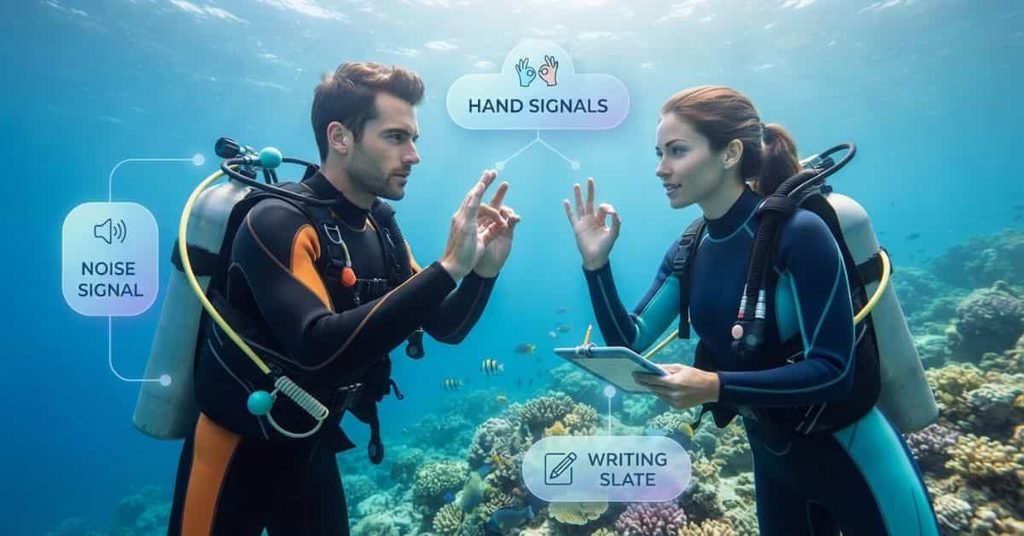
Scuba divers mainly communicate underwater with hand signals instead of spoken words. These simple signals help buddies share instructions, warnings, and important information clearly.
Since speaking clearly underwater can be difficult, most divers rely on scuba diving hand signals to communicate important information with their buddies.
Hand Signals (Primary Method)
Hand signals are the main communication method for recreational scuba divers. Common signals use simple hand movements that divers can recognize underwater.
Many signals follow widely used diving conventions. However, some signals can vary between training agencies, dive teams, or regions. Beginners learn the most important signals during scuba certification and should review them before diving.
Clear hand signals help divers communicate without removing their regulators. They also work when underwater noise makes verbal communication difficult.
Underwater Slates (Writing Boards)
An underwater slate is a small plastic writing board used with a waterproof pencil. Divers can write short messages when hand signals aren’t enough.
Slates work well for longer or more detailed communication. They’re useful during training, instruction, research dives, and situations requiring specific information.
Tank Bangers / Noise Signals
A tank banger creates a sharp noise by striking or vibrating against the scuba tank. Divers can use this sound to get another diver’s attention.
Tank bangers aren’t designed for full conversations. They work better as simple attention signals, especially when divers need to look toward something important.
Most Common Scuba Diving Hand Signals
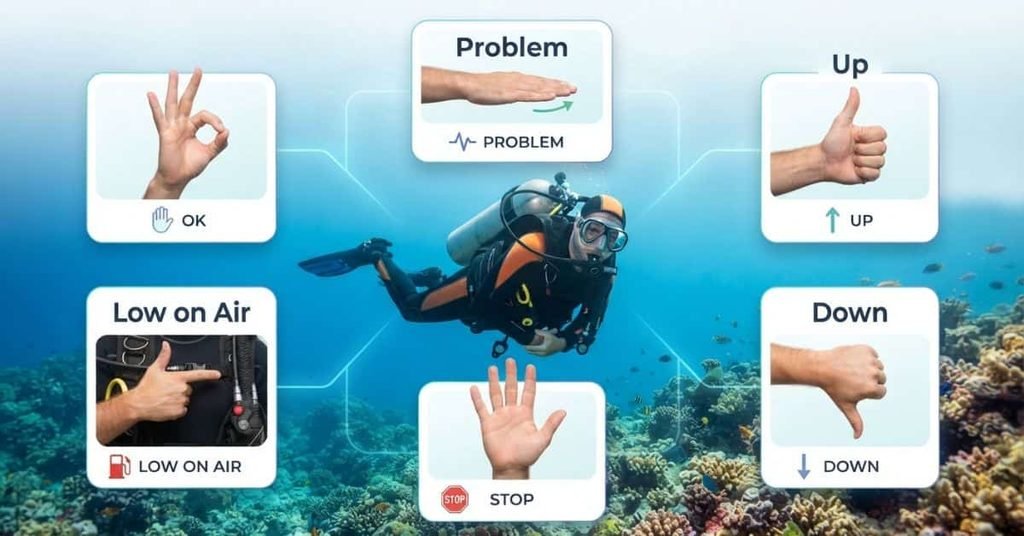
Divers use several common signals to communicate basic information underwater. Learning these signals helps beginners communicate quickly with their dive buddy.
- OK: Everything is fine.
- Problem: Something needs attention.
- Up: Begin or request an ascent.
- Down: Begin or request a descent.
- Low on Air: Your air supply is getting low.
- Stop: Stop moving or wait.
Internal link suggestion: Link “Scuba Diving Hand Signals Guide” to your detailed hand-signal guide for readers who want to learn each signal.
Can Divers Communicate Using Special Equipment?
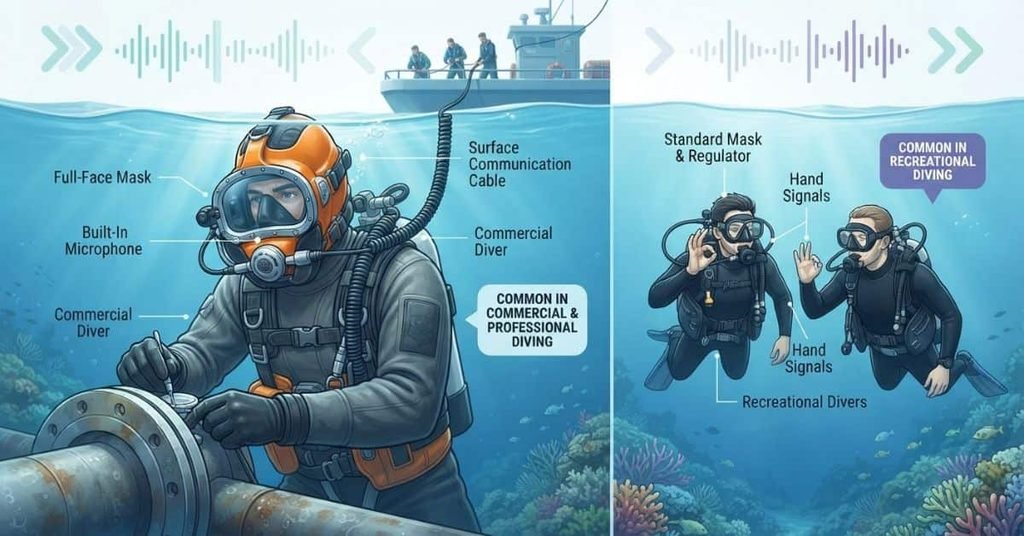
Yes, specialized diving equipment can support voice communication underwater. However, these systems are more common in professional diving than recreational scuba.
Full-Face Masks with Communication Systems
Some full-face masks include built-in communication systems with microphones and speakers. These systems can allow divers to communicate more directly with people on the surface or other equipped divers.
Commercial divers may use these systems during underwater construction, inspection, maintenance, or other professional operations. Rescue and public-safety diving teams may also use specialized communication equipment.
Recreational divers usually don’t need this equipment. Standard scuba gear and hand signals provide simple and effective communication for most recreational dives.
Can You Write Underwater During Scuba Diving?
Yes, scuba divers can write underwater using a waterproof slate and pencil. Slates provide a simple way to communicate when hand signals aren’t enough.
Divers commonly use slates during scuba training and instruction. Instructors may write questions, directions, or explanations for students underwater. Underwater photographers can also use slates to record notes during dives.
Slates work best for short messages. They aren’t as convenient as hand signals for quick communication.
Is Underwater Communication Hard for Beginners?
Underwater communication can feel awkward during your first dive. You may need a moment to remember hand signals while managing your breathing and equipment.
With practice, these signals usually become much more natural. You learn to communicate while staying aware of your buddy, surroundings, and air supply.
Communication skills are practiced in confined water sessions before open water dives. This training gives beginners a controlled environment to practice essential skills before diving in open water.
Good communication also supports safer buddy diving. Before entering the water, divers should review important signals and agree on how they’ll communicate.
Understanding how long you can stay underwater scuba diving can also help you plan your communication, air checks, and buddy interactions during a dive.
Common Beginner Questions About Talking Underwater
Can scuba divers talk underwater at all?
Scuba divers can make sounds underwater, but normal conversation is difficult. The regulator affects speech, while bubbles and water can distort sounds.
Divers may understand simple sounds at close range. However, hand signals remain the more reliable communication method.
Can you shout underwater?
You can try to make a loud sound underwater, but shouting won’t work like it does on land. Your regulator and surrounding bubbles make speech difficult to understand.
If you need someone’s attention, use an agreed signal instead. A tank banger or another noise signal can also help attract attention.
How do divers communicate if visibility is low?
Divers rely more heavily on physical contact, agreed hand signals, and other communication methods when visibility drops.
Buddy teams should stay close and follow their planned communication procedures. Divers may also use lights to attract attention when conditions require them.
Is underwater communication safe?
Yes, standard underwater communication methods are designed to help divers share important information safely. Hand signals, slates, and attention signals can all support clear communication.
Beginners should learn these methods during proper scuba training. Always follow your instructor’s guidance and your dive team’s agreed procedures.
Safety Importance of Underwater Communication
Clear underwater communication plays an important role in safe scuba diving. Divers use signals to share information with their buddy throughout the dive.
The buddy system depends on reliable communication. Divers need to signal problems, changing conditions, low air, or the need to ascend. Clear signals help both divers understand what to do without unnecessary confusion.
A pre-dive briefing also prepares divers for communication underwater. Buddies should review important hand signals, emergency procedures, and what to do if they become separated.
Clear communication can also help prevent panic. When divers understand their buddy’s signals, they can respond calmly when something unexpected happens.
Underwater communication forms part of beginner scuba training and certification. New divers practice essential hand signals and communication skills before applying them during open-water dives.
Pro Tip: Review your most important hand signals before every dive. A quick refresher can make underwater communication faster and more confident.
Conclusion
Scuba divers generally can’t talk normally underwater, but they have several reliable ways to communicate. Hand signals remain the main method for recreational divers.
Understanding can you talk underwater while scuba diving helps beginners know what to expect. With proper training, underwater communication quickly becomes simple and natural.
Learn common scuba diving hand signals before your first open-water dive. Practice them with your buddy and review important signals during your pre-dive briefing.
If you’re new to scuba diving, explore our other beginner guides for helpful safety and training tips. You can also share your first underwater communication experience in the comments.
Frequently Asked Questions
Can scuba divers talk underwater?
Scuba divers can make sounds underwater, but normal conversation isn’t practical. The regulator sits in your mouth and makes clear speech difficult. Bubbles can also distort sounds, while water changes how sound travels. Other divers may hear muffled sounds, especially nearby. However, spoken words aren’t reliable for communication. Recreational divers mainly use standard hand signals to share important information underwater.
Why is it difficult to talk while scuba diving?
Talking underwater becomes difficult because you breathe through a scuba regulator. The regulator changes how you produce and hear speech. Air bubbles can also interfere with sounds around you. Water carries sound differently than air, which can make speech seem distorted. These factors make normal conversation unreliable. That’s why scuba divers learn hand signals as their primary communication method.
How do scuba divers communicate underwater?
Scuba divers mainly communicate using hand signals. These signals allow buddies to share important information without speaking. Common signals communicate messages such as OK, stop, up, down, problem, and low on air. Divers can also use underwater slates for written messages. Noise signals, such as tank bangers, can attract attention. Beginners learn essential communication signals during scuba training.
Can you shout or make sounds underwater while scuba diving?
You can make sounds underwater while wearing scuba equipment, but shouting doesn’t work like it does on land. Your regulator affects speech, while bubbles can make sounds harder to understand. Nearby divers might hear a muffled sound, but they may not understand your words. If you need someone’s attention, use an agreed hand signal or appropriate noise signal instead.
Can scuba divers write underwater?
Yes, scuba divers can write underwater using a waterproof slate and pencil. Slates provide a useful way to communicate longer or more specific messages. They’re commonly used during scuba training and instruction. Divers may also use them during research or photography dives. However, writing takes more time than using hand signals. For quick communication, standard signals remain the better choice.
What hand signals do scuba divers use?
Scuba divers use hand signals to communicate important information underwater. Common signals include OK, problem, stop, up, down, and low on air. Divers may also use signals for air pressure, direction, and other dive situations. Exact signals can vary between training systems or dive teams. Beginners should learn the signals taught by their instructor and review them before diving.
Is underwater communication difficult for beginner scuba divers?
Underwater communication may feel awkward during your first few dives. Beginners must remember hand signals while managing breathing, equipment, and their surroundings. Practice makes communication much easier and more natural. Beginner scuba courses provide controlled opportunities to practice essential signals before open-water diving. Reviewing signals with your buddy during the pre-dive briefing can also improve confidence and reduce confusion underwater.

Scuba Diving Researcher & Beginner Guide
Evan Calder is the creator of DiveBeginner, a website dedicated to helping beginners learn scuba diving simply and practically 🌊
He focuses on scuba fundamentals, beginner safety, and clear diving guidance. Evan has studied ocean and marine science through programs at the Scripps Institution of Oceanography, UC San Diego, a globally recognized leader in ocean research.
Instead of complex technical language, Evan provides easy-to-follow, beginner-friendly guides based on real-world research, helping first-time divers feel confident before their first dive 🤿
DiveBeginner reflects his passion for making scuba diving accessible, safe, and enjoyable for everyone.