Table of Contents
Introduction
A scuba certification can be exciting, but the price can feel confusing when every dive shop lists different fees.
If you’re wondering how much does getting scuba certified cost, you’re not alone. Beginners in the USA often see different prices for courses, equipment, pool sessions, and open-water dives.
The advertised course price may not cover every expense. Equipment rentals, certification fees, boat trips, dive-site fees, and travel can increase your final budget.
This guide breaks down the real cost of scuba certification in simple terms. You’ll learn what most courses include and which expenses may cost extra.
We’ll also compare local dive shops with resort courses and explain PADI versus SSI pricing. You’ll see how online learning, accelerated courses, and equipment choices can affect your budget.
If you’re planning to get certified, you’ll also want to know how to become scuba certified and what the training process involves.
By the end, you’ll know what to ask before booking a course. You’ll also have a clearer idea of how much to budget for your first scuba certification.
How Much Does Scuba Certification Cost?
For beginners in the USA, a full Open Water scuba certification commonly costs about $400–$700, although prices can fall below or rise above that range. Current U.S. course listings show examples around $499–$599, while some operators charge separately for training stages or equipment.
The biggest mistake is comparing only the advertised course price. A low price may cover only part of your training. PADI also warns that very low course prices may exclude online learning or scuba gear.
A complete package may include:
- Online or classroom theory
- Confined-water or pool training
- Open-water certification dives
- Instructor fees
- Rental scuba equipment
- Certification processing
- Tanks and weights
Some shops bundle nearly everything into one price. Others separate these costs, so always check the complete package before booking.
Location also makes a major difference. A local dive shop can reduce travel expenses, while resort certification may add accommodation, transportation, and vacation costs. Resort packages can include more services, but the total trip cost matters more than the course price alone.
What Is Usually Included in the Price?
A beginner certification has three main training stages: knowledge development, confined-water practice, and open-water dives. These stages form the foundation of entry-level scuba certification.
Theory or knowledge development teaches basic diving concepts, equipment use, safety procedures, and dive planning. Many modern courses use online learning, while some shops offer classroom instruction.
Confined-water training usually takes place in a pool or similar environment. You practice essential skills under direct instructor supervision before entering open water.
Open-water training lets you apply those skills in a real diving environment. For PADI Open Water certification, the standard course includes four open-water dives.
Your course price may also include instructor time, tanks, weights, BCDs, regulators, and other rental equipment. However, equipment policies differ between dive centers. Some packages include full gear, while others require students to bring or rent certain items separately.
Certification processing may also be included. For example, some PADI course packages specifically include eLearning and certification fees, while other operators list different components separately.
What May Cost Extra?
Your final scuba certification cost can exceed the advertised course price when certain expenses aren’t included.
Common extras include:
- Personal equipment: You may need your own mask, snorkel, and fins.
- Boat fees: Open-water dives may require boat transportation at some locations.
- Dive-site fees: Marine parks, private sites, or other locations may charge additional fees.
- Transportation: You may need to arrange transport to pools, lakes, beaches, or boat docks.
- Accommodation: Resort courses can require several nights away from home.
- Medical clearance: Some students may need additional medical evaluation before training.
- Learning materials: Manuals, online learning, or other course materials may be separate.
- Certification extras: Some providers may charge separate certification or administrative fees.
The best approach is to ask for an all-in price before paying. PADI specifically recommends asking whether materials, rental gear, boat fees, and certification fees are included.
The total cost can depend on how you complete your training, including whether you choose online scuba certification for the knowledge portion.
Scuba Certification Cost Breakdown
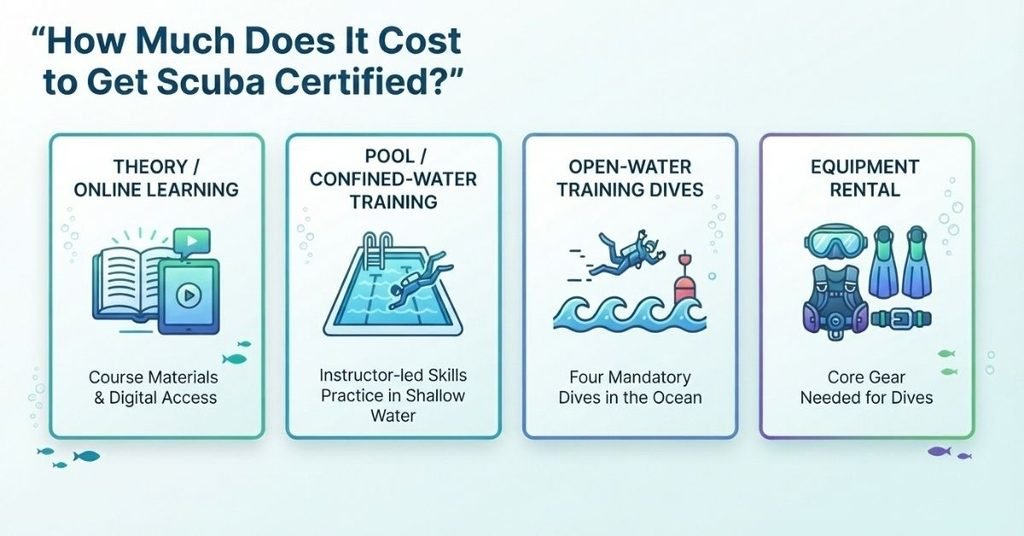
The total cost of scuba certification depends on more than the course fee. Each training stage can include separate costs for instruction, facilities, equipment, and diving access.
Understanding each expense helps you compare dive shops more accurately. It also helps you avoid unexpected charges after enrolling.
1. Theory or Online Learning
Every beginner course includes a knowledge-development component. You’ll learn about dive planning, equipment, pressure changes, safety procedures, and basic diving skills.
Online learning lets you complete the theory portion on your own schedule. It can be convenient for people with busy work or school schedules. Many modern certification programs offer digital learning as part of the course.
In-person classroom training gives you direct access to an instructor. You can ask questions immediately and discuss confusing topics with other students.
The price depends on the certification agency, course provider, learning format, and materials included. Online theory isn’t automatically cheaper because some shops bundle it into the full course price.
The biggest advantage of online learning is flexibility. Traditional classroom training may suit beginners who prefer structured instruction and face-to-face support.
2. Pool or Confined-Water Training
Confined-water training is where you practice essential scuba skills before completing open-water dives. This stage usually takes place in a swimming pool or another controlled environment.
Your costs may include instructor time, pool access, and equipment rental. Some dive centers include these expenses in one package. Others list pool or rental charges separately.
The number of training sessions can also affect your total cost. Your schedule, course format, and learning progress may influence how many sessions you need.
Equipment rental often includes larger items such as a BCD, regulator, tank, and wetsuit. However, policies vary between dive shops.
Before booking, ask whether pool entry and all required equipment are included. A course with a higher upfront price may offer better value if it includes more services.
3. Open-Water Training Dives
Open-water training is the practical stage where you demonstrate your scuba skills in an actual diving environment. For PADI Open Water certification, the standard course includes four open-water training dives.
The price can include instructor costs, tanks, weights, and basic rental equipment. However, boat fees and dive-site charges may be separate.
Some locations allow shore-based training, which can reduce boat-related expenses. Other destinations require boat transportation to reach suitable training sites.
You may also need to pay for transportation between the dive shop and training location. Site entry, marine park, or conservation fees can add another expense where applicable.
Ask the dive center for a complete open-water cost breakdown. This is especially important when comparing courses in different locations.
4. Equipment
Scuba equipment can become a major part of your overall budget, but beginners don’t need to buy everything immediately.
Some items are worth considering for personal use. These include a mask, snorkel, and fins, because proper fit can improve comfort during training.
A wetsuit may also make sense if you plan to dive regularly in similar water temperatures. However, rental options can work well while you’re learning.
Larger equipment usually makes more sense to rent initially. This includes a BCD, regulator, tank, and dive computer, depending on the course and dive shop.
Renting lets you learn what equipment you actually prefer before making expensive purchases. It also reduces your upfront certification budget.
If you eventually dive regularly, buying your own equipment can provide convenience and a consistent fit. Just remember that equipment ownership adds costs beyond certification itself.
| Equipment | Beginner approach |
|---|---|
| Mask | Consider buying |
| Snorkel | Consider buying |
| Fins | Consider buying |
| Wetsuit | Rent or buy |
| BCD | Usually rent initially |
| Regulator | Usually rent initially |
| Dive computer | Rent or buy later |
What Affects the Cost of Scuba Certification?
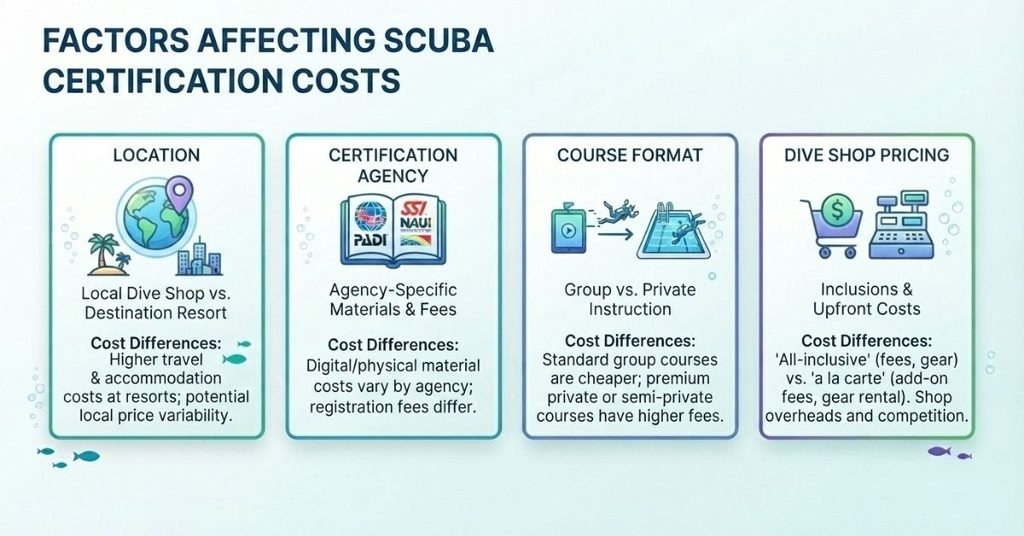
Scuba certification prices can vary widely because dive centers structure their courses differently. Your location, certification agency, course format, and included services all affect the final price.
Looking beyond the headline course fee gives you a more accurate budget. It also makes comparing different certification options much easier.
Location
Where you complete your certification can have a major effect on your total spending. A local dive shop may offer practical training without adding flights, hotels, or vacation expenses.
A coastal destination can provide easy access to open water, but popular locations may have higher operating costs. Dive-site access, boat trips, and local fees can also increase your expenses.
Tropical resorts often market scuba certification as part of a vacation experience. The course itself may seem reasonably priced, but flights, accommodation, meals, transportation, and resort expenses can raise your total budget.
Popular tourist destinations may also have higher demand during busy travel periods. This can affect course availability and pricing.
For a fair comparison, calculate the complete cost of certification plus travel. A higher local course price could still cost less overall than a cheaper resort course.
Pro Tip: Compare the total trip cost, not just the certification fee, when considering a resort course.
Certification Agency
Several recognized agencies offer beginner scuba certification, including PADI, SSI, and NAUI. Other recognized agencies also provide entry-level certification programs.
However, the agency name isn’t always the biggest factor in your final cost. Local dive operators set their own course prices and package different services.
One dive center may include equipment, pool sessions, certification processing, and open-water costs. Another may charge some of these items separately.
Course format also matters. Two shops offering certification through the same agency can have noticeably different package prices.
Focus on what you’re actually getting for your money. Compare the training, instructor support, equipment, practical sessions, and included fees.
The right choice should also consider the agency’s recognition and the quality of the local instructor. Don’t choose a provider based only on the lowest advertised price.
Course Format
Your course format can change both the schedule and the price. A standard course spreads learning and practical sessions across a longer period.
A weekend or accelerated course condenses the training into fewer days. This option can work well for travelers or people with limited free time.
An online plus practical course lets you complete theory remotely before meeting your instructor. This hybrid approach offers flexibility while keeping practical training in person.
Some dive centers also offer referral options. You may complete part of your training with one provider and finish the open-water requirements elsewhere.
A shorter course isn’t automatically cheaper. Accelerated training may involve longer sessions, additional scheduling, or different pricing.
Compare the complete package instead of comparing course duration alone. Your goal should be quality training at a reasonable total cost.
Dive Shop Pricing
Dive shops can package certification costs in very different ways. One provider may advertise an all-inclusive price, while another separates each expense.
Before booking, check whether the quoted price includes:
- Equipment rental
- Pool access
- Instructor fees
- Tanks and weights
- Open-water training
- Boat transportation
- Dive-site fees
- Certification fees
- Learning materials
- Local taxes or other charges
Equipment policies deserve special attention. Some shops provide a complete rental setup, while others expect students to supply personal items.
Pool and open-water fees can also appear separately. Boat trips and site entry charges are particularly important for courses requiring boat-based training.
Ask the dive center for a written breakdown of the full certification cost. This helps you compare providers using the same expenses.
Is PADI Certification More Expensive Than SSI?
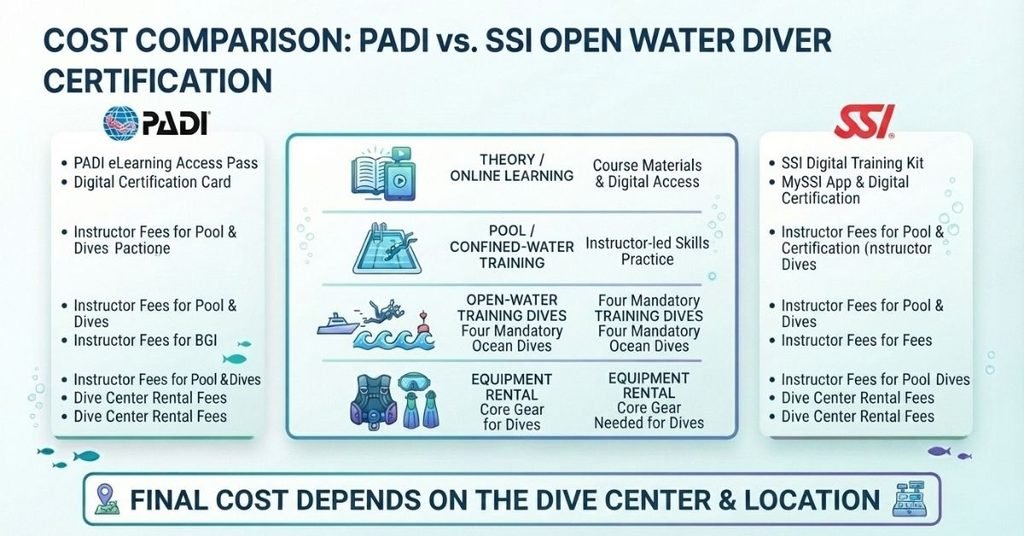
PADI and SSI both offer widely recognized entry-level scuba certification programs. Beginners often compare them because both provide a pathway to becoming certified divers.
The important point is that PADI isn’t universally more expensive than SSI, and SSI isn’t always cheaper. Your final price depends heavily on the dive center, location, course format, equipment, and included services.
PADI
PADI’s beginner certification is commonly known as the Open Water Diver course. It combines knowledge development, confined-water skill training, and open-water dives under instructor supervision.
Your total cost can include online learning, instructor fees, pool sessions, rental equipment, tanks, open-water dives, and certification processing. Some dive centers bundle these expenses into one package.
Other providers may list certain costs separately. Boat trips, dive-site fees, transportation, or equipment rentals can increase the final price.
PADI’s own guidance recommends asking dive shops exactly what’s included before comparing course prices. This helps you avoid choosing a course based only on its advertised starting price.
SSI
SSI also offers an entry-level Open Water Diver certification. Its beginner training similarly combines academic learning, confined-water practice, and open-water training.
The overall cost depends on how the local SSI dive center structures its course. One center may include equipment and training fees, while another may charge some expenses separately.
Location can also create significant differences. A course at a local dive shop may have a very different total price from one offered at a busy coastal resort.
Therefore, compare the complete package rather than assuming SSI certification automatically costs less.
Which One Is Cheaper?
There isn’t a universal answer to whether PADI or SSI is cheaper. Both agencies have different providers, locations, and course packages.
The local dive center often matters more than the agency name. Compare the instructor fees, equipment, pool sessions, open-water dives, certification costs, and additional charges.
Also consider instructor quality and safety practices before choosing. Saving a small amount isn’t worth sacrificing good training or professional support.
Pro Tip: Ask both PADI and SSI dive centers for an itemized quote. Compare the same inclusions before deciding which course offers better value.
Is Online Scuba Certification Cheaper?
Online scuba learning can make certification more convenient, but it doesn’t automatically make the course cheaper. Your final cost still depends on the dive center, practical training, equipment, and other included fees.
The main benefit of online learning is flexibility. You can complete the theory portion around your schedule before attending your practical training sessions.
Online Theory
Online scuba theory lets you study diving concepts remotely instead of attending every classroom session in person. You can usually work through lessons, quizzes, and learning materials at your own pace.
This format can reduce the amount of classroom time you need at the dive center. It may also make scheduling easier if you work full-time or live far from a dive shop.
However, the price depends on how the provider structures its certification package. Some dive centers include online learning in their overall course price. Others may list it as a separate charge.
Online learning can therefore save time without necessarily saving money. Compare the complete course price before assuming it’s the cheaper option.
What Online Learning Does Not Replace
Online learning only covers the academic portion of your scuba training. It doesn’t replace the practical skills you must demonstrate with an instructor.
You’ll still need confined-water training to practice essential scuba skills in a controlled environment. You’ll also need open-water training to apply those skills during actual dives.
Instructor supervision remains an important part of practical training. Your instructor can demonstrate techniques, monitor your skills, and provide feedback while you practice.
You must also complete the required practical assessments for your chosen certification program. Online lessons cannot replace hands-on training or direct instructor evaluation.
This distinction matters when comparing prices. A cheap online theory option isn’t a complete scuba certification by itself.
Hybrid Course vs Traditional Course
Different course formats offer different scheduling advantages, but none guarantees a lower total price.
| Option | Theory | Practical Training | Potential Cost |
|---|---|---|---|
| Traditional | In person | In person | Varies |
| Online + practical | Online | In person | Varies |
| Accelerated | Condensed | In person | Varies |
A traditional course may suit beginners who prefer face-to-face instruction throughout the academic portion.
An online plus practical course offers greater flexibility while keeping hands-on training with an instructor.
An accelerated course condenses the learning schedule but still requires practical training. It may fit travelers or students with limited time.
How Much Does a Weekend or Accelerated Scuba Course Cost?
A weekend scuba course can appeal to beginners who want certification without spreading training across several weeks. However, the shorter schedule doesn’t guarantee a lower price.
If you’re trying to plan your schedule and budget together, check how long scuba certification takes before booking your course.
An accelerated scuba course condenses theory and practical training into a tighter schedule. A standard course may spread the same training across several days or weeks. Both formats still require the necessary knowledge and practical skills for certification.
The price depends on the dive center, location, equipment, training format, and services included. Some accelerated packages may include online theory before the practical sessions. Others may charge separately for equipment, pool access, open-water dives, or certification.
Course duration can affect pricing because instructors may schedule longer or more frequent training sessions. A weekend course can also involve different staffing or facility arrangements.
Finishing faster doesn’t necessarily save money. You may save on repeated travel or accommodation, but the course itself may cost more.
Most importantly, don’t choose a course simply because it offers the fastest certification. Beginners need enough time to understand the material and build comfortable diving skills.
What Are the Hidden Costs of Scuba Certification?
The advertised scuba certification price doesn’t always represent your complete budget. Extra expenses can appear before, during, or after your training.
These costs vary by location and dive center. Knowing about them beforehand helps you avoid surprises and plan a realistic certification budget.
Equipment Costs
You may need some personal equipment during your certification. A properly fitting mask, fins, and snorkel can improve comfort and make skill practice easier.
A wetsuit may also be required depending on the water temperature and dive location. However, many dive centers offer wetsuit rentals during training.
Other optional gear can include a dive computer, surface marker buoy, boots, gloves, or personal accessories. Beginners usually don’t need to purchase every item immediately.
Renting larger equipment can reduce your initial spending. This may include a BCD, regulator, tanks, and other standard training equipment.
Travel and Accommodation
Travel can become a significant expense if you choose a destination or resort course. Flights, hotels, meals, local transportation, and other vacation costs can quickly increase your overall budget.
A local dive shop may eliminate many of these expenses. Compare the complete trip cost when evaluating resort certification.
Dive-Site and Boat Fees
Open-water training may involve costs beyond your course fee. These can include dive-site entry fees, boat trips, and park or conservation fees where applicable.
Ask whether these charges are included in your package. Shore-based training may avoid some boat costs, depending on the location.
Medical and Administrative Costs
Some divers may need medical evaluation before participating in scuba training. Requirements depend on your health history and the certification program’s screening process.
You may also encounter separate charges for certification materials, processing, or other administrative services. Confirm these costs before enrollment.
Additional Training
Not every student completes practical skills at the same pace. You may need additional practice or extra training sessions before meeting certification requirements.
Extra dives can increase your final cost if your original package doesn’t cover them. Specialty courses also create additional expenses after your beginner certification.
Local Dive Shop vs Resort: Which Is Cheaper?
For most beginners, a local dive shop can offer better overall value because you avoid major travel expenses. However, the cheapest option depends on your location and the complete package price.
Local Dive Shop
Getting certified at a local dive center can reduce costs beyond the course fee. You don’t usually need flights, hotel stays, or vacation transportation.
It can also make scheduling easier. Many local shops offer flexible training dates, allowing you to spread your lessons around your normal schedule.
Follow-up support can be another advantage. If you need additional practice, you can return to the same instructor or dive center.
You’ll also train in an environment that’s easier to revisit. This can help if you want to continue diving locally after certification.
Potential advantages include:
- Lower travel and accommodation costs
- Flexible training schedules
- Easier access to additional practice
- Familiar local environment
- Convenient post-certification support
Resort Certification
Resort certification can be convenient if you’re already planning a diving vacation. You can combine your training with warm-water diving and other vacation activities.
A tropical location may also provide an enjoyable first diving experience. However, the course price doesn’t show the complete cost of your trip.
You may need to pay for flights, accommodation, meals, local transportation, and other vacation expenses. These costs can make a cheaper resort course more expensive overall.
Potential advantages include:
- Convenient during an existing vacation
- Warm-water diving environments
- Vacation and certification combined
- Access to popular diving destinations
Pro Tip: Compare the complete cost from your home to certification, not just the advertised course price.
| Option | Course Cost | Travel Costs | Overall Value |
|---|---|---|---|
| Local dive shop | Varies | Usually lower | Often practical |
| Resort course | Varies | Often higher | Best when already traveling |
How to Save Money on Scuba Certification
You don’t need to spend more than necessary to get properly certified. The key is comparing complete course costs and avoiding unnecessary purchases.
Compare Total Package Prices
Don’t choose a course because it has the lowest advertised price. That price may exclude equipment, pool access, open-water dives, or certification fees.
Ask each dive center for a complete price breakdown. Comparing the same services makes it easier to identify the better value.
Ask What Is Included
Before booking, confirm whether your course price includes:
- Scuba equipment rental
- Pool or confined-water sessions
- Tanks and weights
- Open-water training dives
- Boat transportation
- Certification fees
- Online learning or study materials
A slightly higher course fee can provide better value when more services are included.
Consider Renting Equipment
Buying a complete scuba setup can increase your initial budget significantly. Beginners often benefit from renting equipment while they learn what fits and works best.
Consider buying personal items such as a mask and fins when you’re ready. You can rent larger equipment until you gain more diving experience.
Choose a Local Dive Center
A nearby dive center can reduce travel, accommodation, and transportation expenses. It can also make additional practice easier if you need more training.
Local certification can be especially practical if you plan to keep diving after completing your course.
Look for Course Bundles or Promotions
Some dive centers offer legitimate package deals or seasonal promotions. These can reduce your total cost without requiring you to compromise on training quality.
However, don’t choose a provider solely because it’s the cheapest. Check instructor qualifications, safety practices, equipment condition, and course inclusions first.
Pro Tip: Ask for an itemized quote before paying a deposit. It helps you spot missing costs before your training begins.
How Much Should You Budget for Your First Scuba Certification?
Instead of planning around one fixed price, think about your scuba budget in three levels. Your actual spending depends on location, course provider, equipment, and travel plans.
Basic Course Budget
Your basic budget should cover the required certification training. This can include theory, confined-water sessions, open-water dives, instructor fees, and required equipment during training.
Check exactly what’s included before using the course price as your budget. Some providers separate certain training or certification expenses.
Realistic Total Budget
A more realistic budget adds costs that can occur outside the advertised course package. Consider personal equipment, transportation, site fees, and other required charges.
You may also spend money on a mask, fins, or wetsuit if you prefer owning personal gear. Renting equipment can keep your initial spending lower.
Vacation/Resort Budget
A resort certification requires a broader budget. Include the certification course, flights, accommodation, meals, transportation, and additional diving expenses.
This approach gives you a clearer picture of what you’ll actually spend. A low resort course price can still produce a higher overall cost after travel expenses.
How to Choose a Scuba Certification Course
Price matters, but it shouldn’t be your only deciding factor. Good training, qualified instructors, and strong safety practices provide greater value than a bargain course.
Before enrolling, check the following:
- Instructor qualifications: Confirm that instructors hold appropriate teaching credentials.
- Course inclusions: Know exactly what your payment covers.
- Training environment: Check where pool and open-water training will take place.
- Practical sessions: Understand how many required sessions and dives are included.
- Equipment condition: Ask about the condition and maintenance of rental gear.
- Student-to-instructor ratio: Smaller groups may provide more individual attention.
- Reviews and reputation: Look for consistent feedback about instruction and professionalism.
- Agency recognition: Check which recognized certification agency provides the credential.
- Safety practices: Ask how the center handles equipment checks, emergencies, and weather changes.
- Refund policy: Understand cancellation and refund terms before making payment.
A reputable dive center should clearly explain its training process and costs. It should also answer reasonable questions without pressuring you to book immediately.
Conclusion
Scuba certification costs vary based on your location, dive shop, course format, equipment, and included fees. The real cost can extend beyond the advertised course price, especially for resort training.
If you’re wondering how much does getting scuba certified cost, focus on the complete package rather than one headline price. Compare training, equipment, open-water dives, boat fees, certification costs, and travel expenses before booking.
A local dive center may offer better overall value, while online learning can provide useful scheduling flexibility. Most importantly, don’t sacrifice instructor quality or safety to save a few dollars.
Ready to start planning your certification? Compare local courses carefully and choose the option that fits your budget and diving goals. Share your certification experience in the comments!
For beginners in the USA, scuba certification often costs around $400–$700 for the course and core training. Prices vary by dive center and location. Equipment rental, boat fees, dive-site charges, and travel may cost extra. Always ask for an itemized quote before booking.
Becoming scuba certified can cost more than the advertised course price. Your final budget may include training, equipment, certification fees, transportation, and open-water expenses. A local course can reduce travel costs, while resort certification may add accommodation and other vacation expenses.
A beginner should generally expect several hundred dollars for certification. The exact amount depends on what’s included in the course package. Ask whether theory, pool training, equipment, open-water dives, and certification fees are included.
Scuba certification can be affordable when you choose a local provider and rent equipment. Resort training and additional gear can increase your total spending. The best value comes from comparing complete course packages rather than choosing the lowest advertised price.
Not necessarily. PADI and SSI certification costs vary by dive center, location, and course package. One provider may include equipment and certification fees, while another charges separately. Compare the complete package before deciding which agency offers better value.
Yes, you can reduce costs without cutting corners on training. Compare local dive centers, ask about package discounts, and rent larger equipment instead of buying everything immediately. Check all included fees before choosing a course.
Online theory can offer flexibility, but it isn’t always cheaper. You’ll still need confined-water training, open-water dives, instructor supervision, and practical assessments. Compare the total price of online learning plus practical training with traditional classroom courses.
It can, especially when you include the complete vacation cost. Flights, accommodation, meals, transportation, and additional diving can increase your spending. A resort course may make sense if you’re already planning the trip, but compare the total cost with local certification.

Scuba Diving Researcher & Beginner Guide
Evan Calder is the creator of DiveBeginner, a website dedicated to helping beginners learn scuba diving simply and practically 🌊
He focuses on scuba fundamentals, beginner safety, and clear diving guidance. Evan has studied ocean and marine science through programs at the Scripps Institution of Oceanography, UC San Diego, a globally recognized leader in ocean research.
Instead of complex technical language, Evan provides easy-to-follow, beginner-friendly guides based on real-world research, helping first-time divers feel confident before their first dive 🤿
DiveBeginner reflects his passion for making scuba diving accessible, safe, and enjoyable for everyone.