Table of Contents
Introduction
Have you ever wondered if you can scuba dive without getting certified first?
If you’re planning your first underwater adventure in the USA, certification rules can feel confusing. You may have heard that beginners can try scuba diving without certification. However, regular recreational diving usually requires proper training and certification.
So, do you have to be certified to scuba dive? The short answer depends on the type of dive you plan to take. Some dive operators offer supervised introductory experiences for beginners. These let you try scuba without becoming fully certified.
If you decide to pursue certification, it helps to understand how to become scuba certified and what training you’ll need.
In this guide, you’ll learn when certification is required and when it may not be. We’ll also explain PADI and other certification agencies, age requirements, safety risks, and trial dives.
By the end, you’ll know exactly what to expect before booking your first scuba diving experience. You’ll also understand whether you should try a Discover dive or pursue full certification.
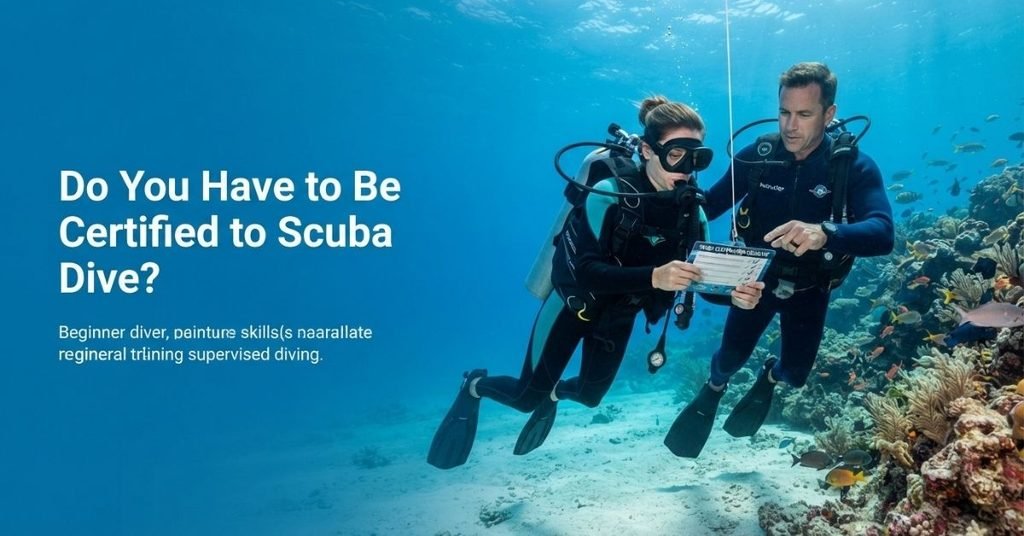
Do You Have to Be Certified to Scuba Dive?
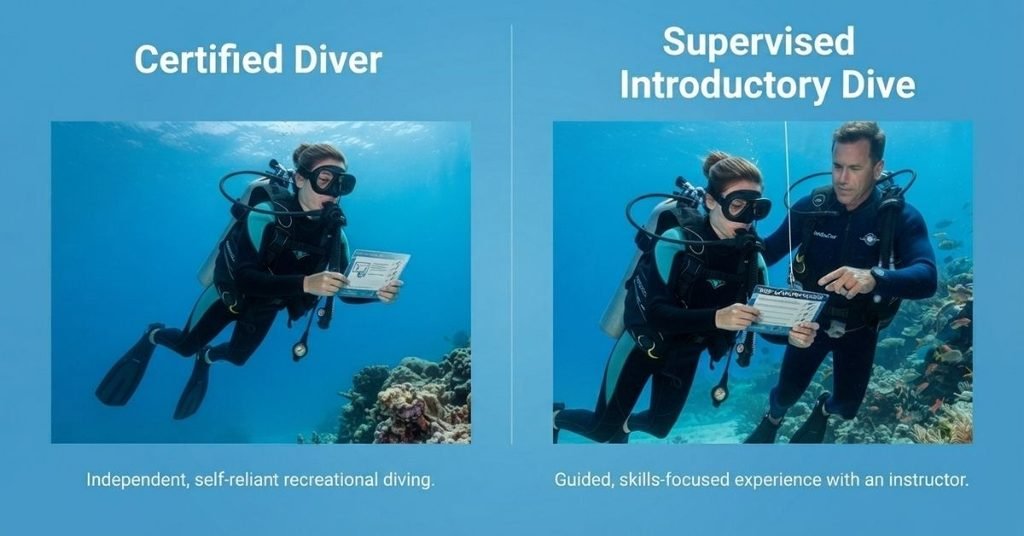
Yes, you generally need scuba certification for independent recreational diving. Certification shows that you’ve learned essential skills, equipment use, and basic dive safety. Most dive operators require proof before allowing certified divers to rent gear or join certain dives.
However, you don’t always need full certification to experience scuba diving. Many operators offer supervised introductory experiences for beginners. These dives take place under an instructor’s direct guidance and follow specific limits.
So, do you need to be certified to scuba dive? If you want to dive independently, rent equipment, or join dives that require certification, the answer is usually yes. If you only want to try scuba for the first time, a supervised beginner experience may be available.
When Certification Is Normally Required
Certification usually becomes important when you plan to dive beyond a supervised introductory experience. Certified divers have completed structured training and demonstrated basic scuba skills.
You’ll commonly need certification when:
- Diving independently: Recreational scuba diving requires appropriate training and certification.
- Renting scuba equipment: Many dive shops ask for certification before renting tanks and other equipment.
- Joining guided dives: Some guided trips require proof of certification before departure.
- Going beyond introductory dives: Deeper or more demanding dives may require suitable certification and experience.
- Using specialized equipment or sites: Certain activities may require additional training or qualifications.
Dive operators check certification to match divers with suitable activities and safety requirements. Your certification level also helps them understand your training and experience.
If you’re asking, do you have to get certified to scuba dive, think about what you want to do underwater. Certification is the normal route for regular recreational diving.
Pro Tip: Always confirm certification requirements with the dive operator before booking. Rules can differ based on the location, dive conditions, and planned activity.
When You May Dive Without Full Certification
Beginners can sometimes scuba dive without holding a full certification. These experiences happen under close instructor supervision and don’t qualify you as a certified diver.
Common options include:
- Supervised introductory dives: An instructor guides you through basic skills and the dive.
- Resort experiences: Some resorts offer beginner programs, often called “Discover Scuba” experiences.
- Pool sessions: Confined-water experiences let beginners practice basic scuba skills in controlled conditions.
- Instructor-controlled dives: The instructor manages the activity and keeps the experience within defined limits.
These experiences don’t give you the same privileges as full certification. You generally can’t use them to dive independently afterward.
Depth limits, equipment rules, supervision requirements, and eligibility can vary by operator and program. Always check the specific conditions before participating.
For beginners wondering do you have to be scuba certified, the key distinction is simple: trying scuba with an instructor isn’t the same as becoming certified.
Can You Scuba Dive Without Certification?
Yes, you may be able to scuba dive without full certification in a supervised beginner program. However, this differs from being qualified to dive independently. An introductory experience lets you try scuba under controlled conditions. It doesn’t replace formal certification.
For beginners in the USA, this distinction matters when choosing a dive experience. A supervised trial can help you decide whether scuba diving suits you. Regular recreational diving requires more comprehensive training and appropriate certification.
Trial or Discover Scuba Dives
A trial or Discover Scuba dive introduces beginners to basic scuba diving. An instructor explains the equipment and guides you through the experience.
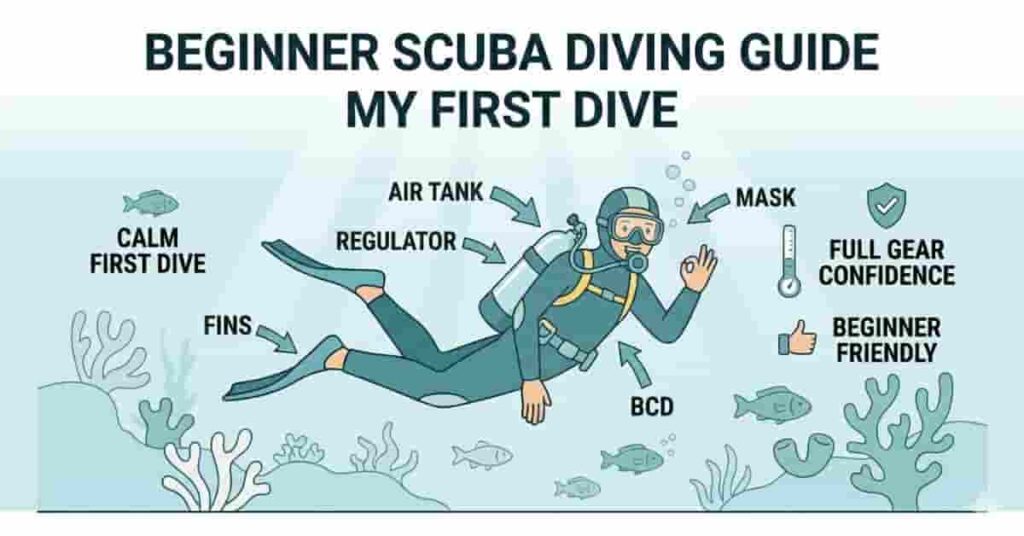
You’ll usually receive an orientation covering equipment such as your mask, regulator, BCD, and tank. You may also practice simple skills before entering the water.
The instructor remains responsible for supervising the experience. The dive also stays within defined depth and environmental limits.
These programs suit beginners because they provide a controlled way to experience breathing underwater. You don’t need to commit to a full certification course immediately.
What You Cannot Do as an Uncertified Diver
An introductory dive doesn’t give you the same privileges as a certified diver. You remain under the conditions established by the instructor and dive operator.
As an uncertified diver, you generally cannot:
- Dive independently without appropriate certification and training.
- Treat a trial dive as proof of scuba certification.
- Ignore the operator’s depth, supervision, or equipment restrictions.
- Rent scuba equipment when the shop requires certification.
- Join dives that require a specific certification level.
These restrictions help match the dive to your training and experience. They also prevent beginners from entering environments beyond their current skills.
Why Rules Can Vary
There isn’t one universal rule for every scuba diving experience. Requirements can change depending on the operator, location, and type of dive.
For example, a resort may offer a supervised beginner experience with specific depth limits. Another operator may require certification before allowing participation in the same type of dive.
Other factors can include:
- Dive operator policies: Businesses can set their own participation requirements.
- Location: Local rules and diving conditions can affect requirements.
- Type of dive: Wreck, night, deep, and specialty dives may require additional training.
- Depth and environment: More demanding conditions can require greater experience.
- Local regulations: Applicable laws or regulations may impose additional requirements.
Do You Have to Be PADI Certified to Scuba Dive?
No, you don’t have to be PADI certified to scuba dive. PADI is one of several major scuba training organizations worldwide. A certification from another recognized agency can also qualify you for many recreational dives.
The important point is having appropriate scuba training and certification, not necessarily a PADI certification. Dive operators may accept certifications from different recognized agencies, depending on their policies and the planned dive.
Is PADI Certification Required?
PADI, or Professional Association of Diving Instructors, offers widely used recreational scuba training programs. However, PADI isn’t the only organization that certifies recreational divers.
If you’re wondering, do you have to be PADI certified to scuba dive, the answer is generally no. A recognized certification from another agency may meet an operator’s requirements.
Before booking a dive, check which certifications the operator accepts. Requirements can also change for advanced, specialty, or demanding dives.
PADI vs. Other Certification Agencies
Several organizations provide scuba training and certification. Their courses can differ in structure, terminology, and program details.
- PADI: Offers a broad range of recreational and professional scuba training.
- SSI: Provides recreational scuba education through its own training system.
- NAUI: Offers recreational, technical, and professional scuba training.
- CMAS: An international diving organization with affiliated federations and training systems.
You don’t need to study every agency before starting. Focus on choosing a reputable training program that matches your diving goals.
Why Dive Shops Check Your Certification
Dive shops check certification because your training level helps determine which activities are appropriate. They may ask for certification details before accepting a booking or renting equipment.
Certification helps operators:
- Verify your completed training.
- Match you with suitable dives.
- Determine equipment rental eligibility.
- Follow their safety and operational procedures.
Pro Tip: Contact the dive shop before your trip and confirm which certification cards they accept. Also ask whether the planned dive requires additional training or experience.
How Old Do You Have to Be to Get Scuba Certified?
There isn’t one universal scuba certification age for every agency or country. Minimum ages depend on the training organization and program. For example, PADI and SSI both offer junior entry-level certification programs starting at age 10.
So, how old do you have to be scuba certified? For many beginner programs, children can start around age 10. Younger children may have access to introductory pool programs instead of full certification.
If you’re in the USA, check the specific agency and dive center before enrolling. You can also read our dedicated [Scuba Diving Age Requirements] guide for a detailed breakdown.
Minimum Age for Scuba Certification
Minimum ages depend on the certification agency and the specific program. PADI currently lists age 10 as the minimum for its entry-level scuba training in most areas. Divers younger than 15 receive Junior Open Water Diver certification.
SSI also lists age 10 as the minimum for junior entry-level certifications. This shows why you shouldn’t treat one age as a universal worldwide requirement.
Youth certifications also come with additional restrictions. These can include depth limits, buddy requirements, and closer supervision.
For example, PADI Junior Open Water Divers ages 10–11 have a 12-meter (40-foot) maximum depth. Divers ages 12–14 have an 18-meter (60-foot) limit and must dive with a certified adult.
Do Children and Teenagers Need Different Programs?
Children and teenagers may use youth-specific certification programs designed around their age and experience. These programs teach core scuba skills while adding appropriate restrictions.
For example, PADI’s Junior Open Water program uses the same basic training foundation as its standard course. However, younger divers have shallower depth limits and specific buddy requirements.
Parents or guardians may also need to provide permission for minors. PADI requires parent or guardian permission for certain younger participants.
Youth programs can also use closer instructor supervision and smaller student groups. These measures help instructors provide suitable guidance during training.
Are There Health Requirements?
Scuba training also involves health screening, not just age requirements. Students typically complete a medical questionnaire before beginning a recreational scuba course.
Certain medical conditions may require evaluation by a doctor before diving. A “yes” answer on a screening questionnaire doesn’t automatically mean you cannot dive. It may mean you need professional medical clearance first.
Fitness and swimming ability can also matter. Training programs may require basic swimming and water-comfort skills before certification.
Why Is Scuba Certification Important?
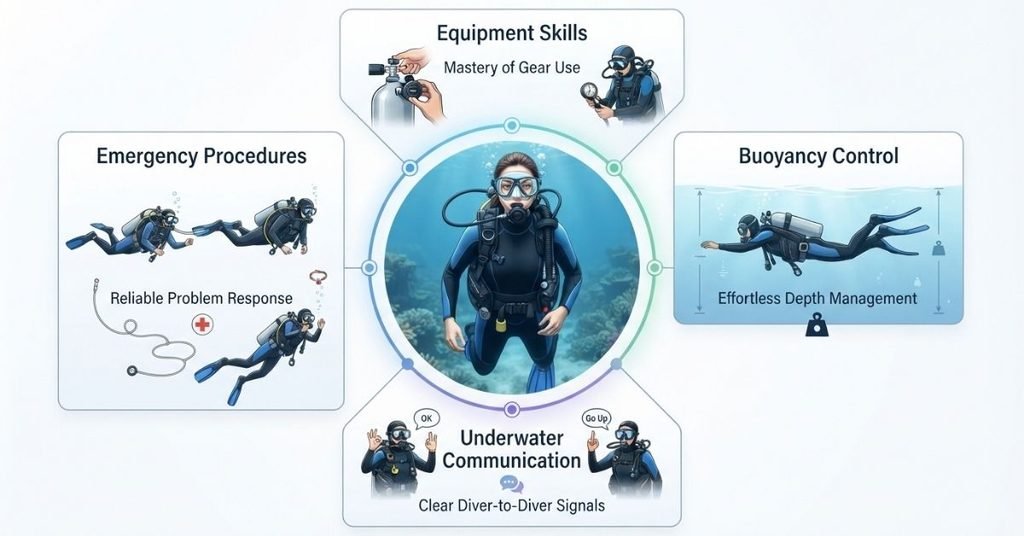
Scuba certification teaches you more than how to breathe underwater. It builds the knowledge and practical skills needed to manage equipment, control your position, and respond to common diving problems.
For beginners, proper training can make underwater experiences more controlled and predictable. It also helps you understand your limits before you begin regular recreational diving.
Learn How to Use Scuba Equipment
A certified diver needs to understand how their equipment works before entering open water. Training introduces the main components and teaches you how to use them correctly.
You’ll learn about equipment such as:
- Regulator: Delivers breathing gas from the tank at a usable pressure.
- BCD: Helps control buoyancy and manage your position in the water.
- Tank: Stores the breathing gas used during the dive.
- Mask: Creates an air space around your eyes and nose underwater.
- Weight system: Helps you achieve appropriate buoyancy with your equipment.
Understanding this equipment helps you recognize problems and use your gear confidently.
Learn Essential Underwater Skills
Certification also teaches practical skills that make diving safer and easier to manage. These skills help you control your body and equipment underwater.
Key skills include:
- Buoyancy control: Helps you maintain a comfortable position without unnecessary effort.
- Equalization: Helps manage pressure changes in your ears and other air spaces.
- Controlled ascents: Teaches you how to return toward the surface safely.
- Underwater communication: Helps you communicate with your buddy using standard hand signals.
Good buoyancy skills can also help reduce accidental contact with the bottom or marine life.
Learn How to Respond to Problems
Scuba training prepares you for problems that can occur underwater. The goal isn’t to expect emergencies, but to know what to do if something goes wrong.
Training covers situations such as equipment problems, low air supply, and losing contact with a buddy. You also learn basic emergency procedures and how to respond calmly.
One important concept is avoiding rushed decisions. Staying calm, communicating with your buddy, and following your training can help you manage unexpected situations.
Pro Tip: Certification is only the beginning. Stay within your training, experience, and current conditions when planning future dives.
What Are the Risks of Scuba Diving Without Proper Training?
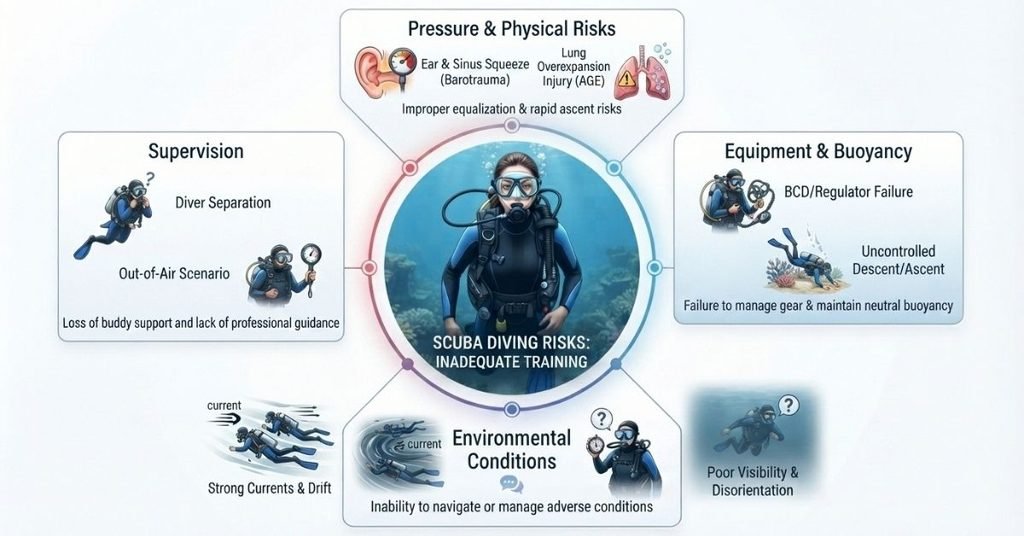
Scuba diving involves equipment, changing pressure, and an underwater environment. Proper training teaches you how to manage these factors before you dive independently.
Without suitable training, simple mistakes can become harder to manage underwater. That doesn’t mean every uncertified dive is unsafe. Supervised introductory programs specifically control the environment and provide instructor guidance.
Physical Risks
Pressure changes affect the air spaces in your body during descent and ascent. Training teaches divers how to manage these changes correctly.
Common physical risks can include:
- Barotrauma: Pressure differences can injure the ears, sinuses, lungs, or other air spaces.
- Pressure-related injuries: Rapid or improper pressure changes can cause serious problems.
- Decompression illness: Improper diving practices can contribute to decompression-related illness.
- Poor equalization: Failing to equalize properly can cause pain or injury.
- Improper ascents: Ascending too quickly or ignoring established procedures can increase risk.
These risks are why scuba courses teach controlled ascents, equalization, and basic dive planning.
Equipment and Buoyancy Risks
Scuba equipment requires more than simply putting on a tank and regulator. Divers need to understand how their equipment works and how to respond when something feels wrong.
Poor equipment handling can affect breathing, buoyancy, and overall control. Poor buoyancy can also increase air consumption and make it harder to maintain a comfortable position.
Untrained divers may also struggle with air management, equipment adjustments, or unexpected situations. Stress can then lead to panic or disorientation.
Proper training gives divers practical experience with these skills before they dive independently.
Environmental Risks
The underwater environment can change quickly. Conditions that seem manageable from the surface may feel different once you’re underwater.
Important environmental factors include:
- Currents: Water movement can make swimming and maintaining position harder.
- Low visibility: Reduced visibility can make navigation and buddy contact more difficult.
- Depth: Greater depth increases pressure and changes the demands of a dive.
- Cold water: Cold conditions can affect comfort, equipment, and physical performance.
- Marine environment: Rocks, structures, animals, and other hazards require awareness and appropriate behavior.
Training helps divers recognize these conditions and stay within their experience level.
Why Supervision Matters
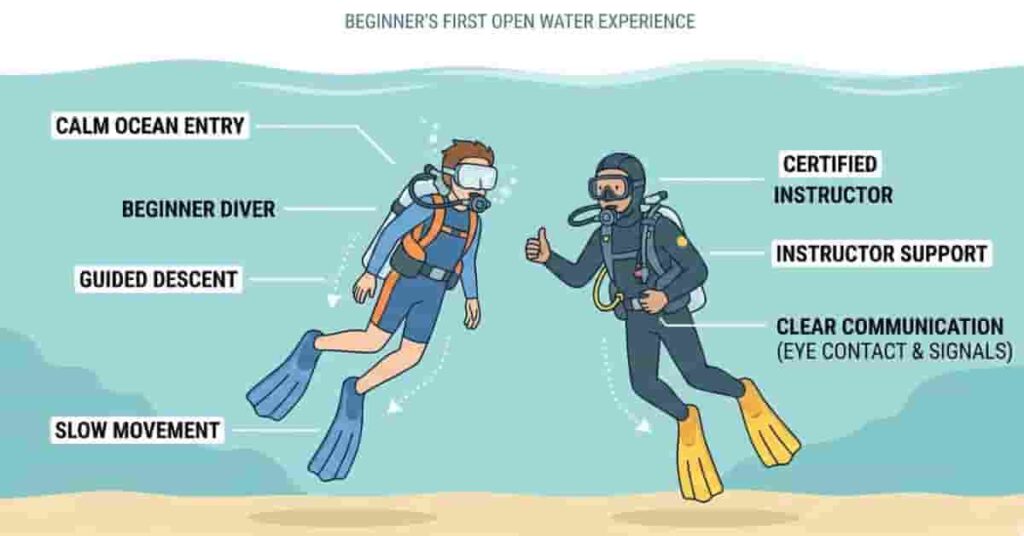
Instructor supervision provides an important safety layer during introductory scuba experiences. The instructor controls the activity and helps beginners respond to problems.
A supervised experience typically includes:
- Instructor guidance: A trained professional stays involved throughout the experience.
- Controlled environment: Beginners start within conditions suited to their training.
- Pre-dive briefing: The instructor explains equipment, procedures, signals, and restrictions.
- Emergency support: The instructor can respond if a beginner experiences difficulty.
Trial Dive vs. Full Scuba Certification
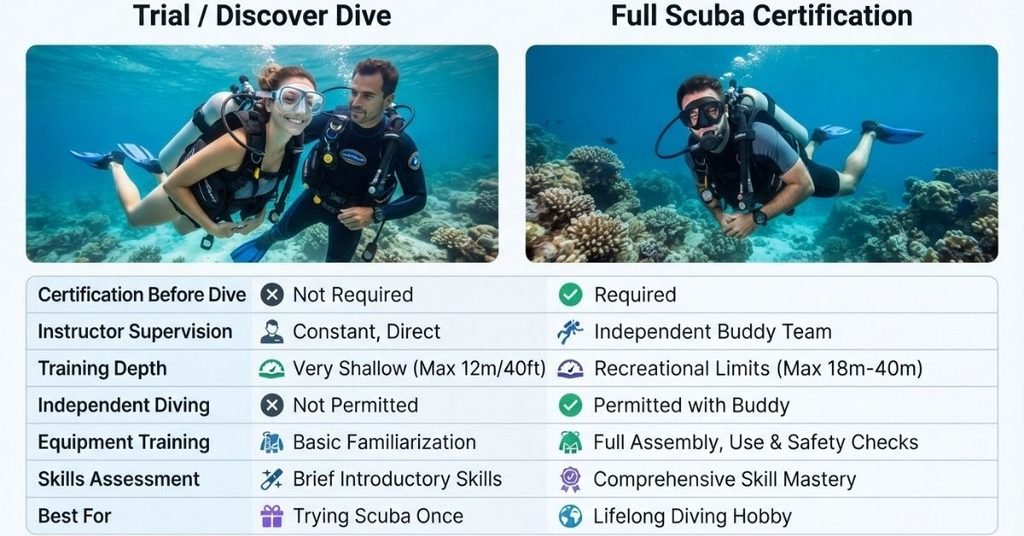
A trial dive and full certification serve different purposes. A trial dive lets you experience scuba under supervision. Certification prepares you for appropriate independent recreational diving.
| Feature | Trial/Discover Dive | Full Certification |
|---|---|---|
| Certification required beforehand | Usually no | Yes |
| Instructor supervision | Required | Included during training |
| Training depth | Introductory | Comprehensive |
| Independent diving | No | Yes, within certification limits |
| Equipment training | Basic | Detailed |
| Skills assessment | Limited | Required |
| Best for | Trying scuba | Regular recreational diving |
A trial dive focuses on introducing beginners to breathing underwater and basic scuba equipment. Full certification involves structured learning, skill practice, and open-water training.
Certification doesn’t automatically qualify you for every type of dive. Your training level, experience, and the dive’s conditions still matter.
Which Option Is Better for a First-Time Diver?
The better choice depends on your goals. If you’re simply curious about scuba, a supervised introductory experience can be a good starting point.
If you already know you want to dive regularly, full certification makes more sense. It provides broader training and allows you to participate in appropriate recreational dives.
Remember, a trial dive is an introduction, not a substitute for certification. It lets you explore scuba under controlled conditions without claiming that you’ve completed a certification course.
How Do You Get Scuba Certified?
Getting scuba certified involves learning basic diving knowledge, practicing essential skills, and completing supervised open-water training. The exact course structure varies by certification agency and training center.
For beginners in the USA, the process usually combines learning materials, confined-water practice, and open-water dives. You don’t need to master everything before starting. Your instructor guides you through each stage.
1. Complete the Learning/Knowledge Portion
The first stage teaches the basic knowledge you need before entering open water. You’ll learn how scuba equipment works and how pressure affects your body underwater.
Key topics usually include:
- Basic scuba theory and diving principles
- Equipment use and care
- Basic safety procedures
- Air consumption and dive planning
- Pressure changes and equalization
This knowledge helps you understand why divers follow specific procedures underwater.
2. Practice in Confined Water
Next, you’ll practice essential scuba skills in a controlled environment. This often takes place in a swimming pool or another suitable confined-water area.
You’ll practice skills such as:
- Using and adjusting your scuba equipment
- Controlling buoyancy
- Clearing your mask
- Regulator recovery
- Basic underwater communication
Your instructor supervises these sessions and helps you build confidence before open-water training.
3. Complete Open-Water Training
After practicing the required skills, you’ll apply them during instructor-supervised open-water dives. This gives you experience in real diving conditions.
You’ll practice managing your equipment, buoyancy, communication, and basic dive procedures while following your instructor’s guidance.
4. Receive Your Certification
Once you complete the required learning, skills, and open-water training, the certification agency can issue your certification.
Your certification allows you to participate in appropriate recreational dives within its limits. Future diving should also consider your experience, current conditions, and the operator’s requirements.
For the complete process, see our [How to Get Scuba Certified: Step-by-Step Guide].
Do You Need Certification for Every Type of Scuba Dive?
No. Basic scuba certification doesn’t automatically qualify you for every type of dive. Different environments can require additional training, experience, or specific certifications.
An introductory dive may allow an uncertified beginner to participate under direct supervision. Standard recreational diving generally requires appropriate certification. More demanding activities can have additional requirements.
| Dive Type | Typical Training Requirement |
|---|---|
| Introductory dive | Supervised beginner experience |
| Recreational dive | Appropriate entry-level certification |
| Deeper dive | Additional depth training may apply |
| Night dive | Night-diving training or experience may be required |
| Wreck dive | Wreck-specific training may be appropriate |
| Specialty diving | Relevant specialty training |
| Technical diving | Advanced technical training and experience |
Requirements can vary between dive operators and locations. Always confirm the specific requirements before booking.
Common Myths About Scuba Certification
Scuba certification can seem confusing when beginners hear different advice online. Understanding these common myths makes it easier to know what’s actually required.
Myth 1: “You Can Scuba Dive Anywhere Without Certification”
False. You may be able to try scuba through a supervised introductory experience. However, independent recreational diving normally requires appropriate training and certification.
Dive shops may also require certification before renting equipment or joining certain trips. Requirements depend on the operator and type of dive.
Myth 2: “A Shallow Dive Doesn’t Need Certification”
False. Depth alone doesn’t determine whether certification is required. A shallow dive can still involve equipment, pressure changes, buoyancy control, and underwater communication.
Some supervised beginner programs allow limited diving without full certification. These experiences remain controlled and instructor-led.
Myth 3: “A Trial Dive Makes You Certified”
False. A trial or Discover Scuba experience doesn’t make you a certified diver.
You receive an introduction to scuba under supervision. Full certification requires completing the appropriate learning, skills, and open-water training.
Myth 4: “You Must Be PADI Certified”
False. PADI is one major scuba certification organization, but it’s not the only option.
Other recognized agencies include SSI, NAUI, and CMAS. Dive operators may accept certifications from different agencies, depending on their policies.
Myth 5: “Anyone Can Learn Scuba Skills During Their First Dive”
False. Scuba requires specific knowledge and practical skills. Equipment handling, buoyancy, equalization, communication, and emergency procedures all require proper instruction.
A supervised introductory dive can teach basic skills. It doesn’t replace comprehensive certification training.
Conclusion
Scuba diving doesn’t always require full certification, but independent recreational diving usually does. We covered certification requirements, supervised trial dives, age considerations, safety risks, and different types of scuba training.
So, do you have to be certified to scuba dive? If you want to dive independently, proper certification is the safest and most practical route. Beginners can also try scuba through supervised introductory programs before committing to a full course.
Remember, PADI isn’t the only certification option. Your training, experience, dive conditions, and operator requirements all matter.
Ready to start your scuba journey? Explore our How to Get Scuba Certified guide for the next steps. Share this guide with someone planning their first dive, or tell us about your scuba experience in the comments.
Frequently Asked Questions About Scuba Certification
For independent recreational scuba diving, you generally need appropriate scuba certification. Certification shows that you’ve completed basic training and demonstrated essential diving skills. However, some operators offer supervised introductory experiences for beginners without full certification.
Not always. Some dive centers offer trial or Discover Scuba experiences for beginners without certification. These dives happen under direct instructor supervision and follow specific limits. Regular recreational diving typically requires appropriate certification.
Yes, but usually only through a supervised introductory program. An instructor controls the experience and keeps the dive within defined limits. You cannot treat an introductory dive as equivalent to full scuba certification.
No. PADI is one major scuba certification agency, but other recognized agencies also provide training. Dive operators may accept certifications from organizations such as SSI, NAUI, or CMAS, depending on their policies.
Minimum ages depend on the certification agency and specific program. Many major agencies offer junior scuba certification programs starting around age 10. Youth certifications can include additional depth and supervision restrictions.
No. A Discover Scuba or trial dive provides a supervised introduction to scuba. It doesn’t award full certification or qualify you for independent recreational diving.
Rental policies vary between dive shops and locations. Many operators require proof of appropriate certification before renting scuba equipment. Some may also ask about your certification level or experience for specific equipment.
Most beginners start with an entry-level recreational scuba certification. The course teaches basic diving knowledge, equipment use, underwater skills, and open-water procedures. Your certification level should match the type of diving you plan to do.

Scuba Diving Researcher & Beginner Guide
Evan Calder is the creator of DiveBeginner, a website dedicated to helping beginners learn scuba diving simply and practically 🌊
He focuses on scuba fundamentals, beginner safety, and clear diving guidance. Evan has studied ocean and marine science through programs at the Scripps Institution of Oceanography, UC San Diego, a globally recognized leader in ocean research.
Instead of complex technical language, Evan provides easy-to-follow, beginner-friendly guides based on real-world research, helping first-time divers feel confident before their first dive 🤿
DiveBeginner reflects his passion for making scuba diving accessible, safe, and enjoyable for everyone.