Table of Contents
Introduction
Can you really become a certified scuba diver without ever stepping into the water?
Many beginners in the USA search for can I get scuba certified online before planning their first underwater adventure. Online learning sounds convenient, especially when you have a busy schedule or live far from a dive center.
The good news is that you can complete much of the scuba theory from home. However, online lessons cannot replace essential hands-on training with a qualified instructor.
In this guide, you’ll learn exactly what you can complete online and what requires in-person training. We’ll explain the hybrid certification process, including pool sessions and open-water dives.
Online learning is only one part of certification, so it’s worth understanding how to become scuba certified from start to finish.
You’ll also discover the benefits and limitations of online learning. By the end, you’ll know what to expect before enrolling in a scuba certification course.
Whether you’re completely new to diving or comparing training options, this guide will help you choose a safe and practical path to certification.
What Parts of Certification Can Be Done Online
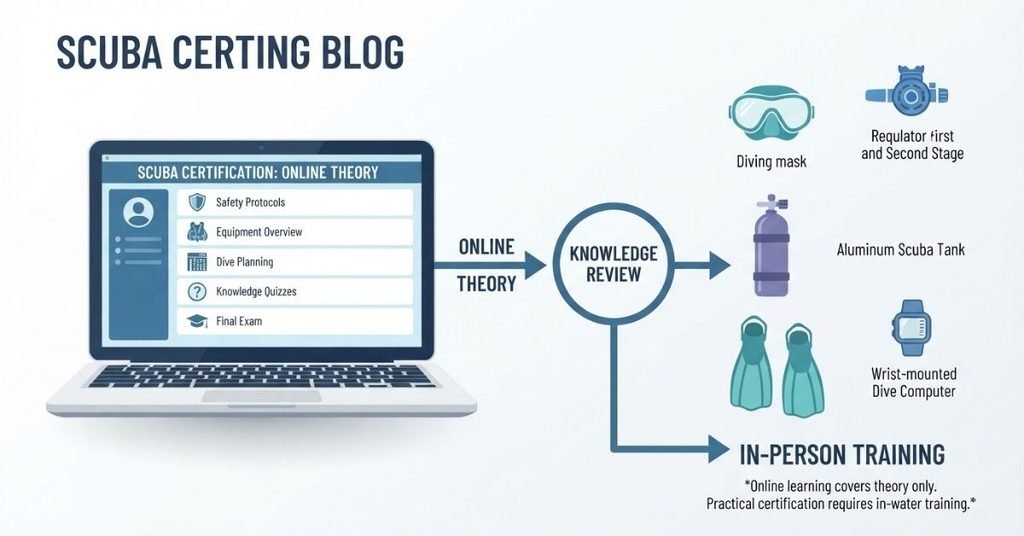
A large part of beginner scuba training can happen online. Digital lessons cover the knowledge you need before entering the water with an instructor.
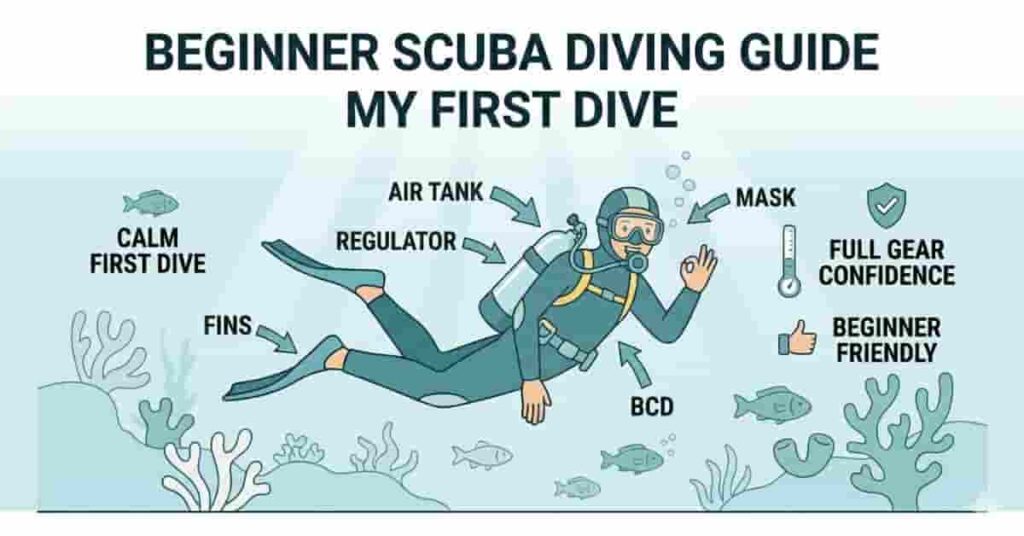
You’ll usually learn about scuba safety, equipment, pressure, buoyancy, communication, and dive planning. Lessons may also explain how to manage air supply and respond to common diving problems.
If you’re planning your training around work or school, learn how long scuba certification takes before choosing a course.
Online courses typically include short quizzes after each lesson. These quizzes help you check your understanding before moving forward. Some programs also require a final knowledge exam.
The online portion offers flexibility because you can study from home. You can pause lessons, review difficult topics, and learn around your schedule.
The time needed varies by course and your learning pace. Some beginners finish quickly, while others spread their lessons across several days or weeks. Check the course requirements before enrolling.
For a complete timeline, see our internal guide: [How Long to Be Scuba Certified?]. It explains the full certification process, including practical training.
What Must Be Done In-Water
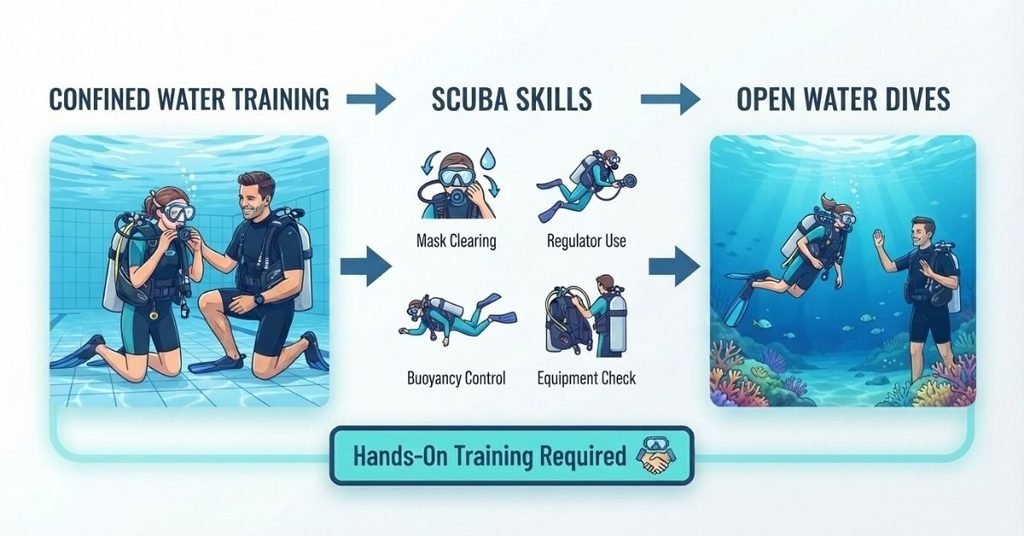
Online lessons can teach scuba knowledge, but they can’t replace hands-on water training. You must demonstrate essential diving skills under qualified instructor supervision.
Your practical training usually starts in confined water, often a swimming pool or calm, shallow area. This controlled environment lets you practice skills without the challenges of open water.
You may practice removing and replacing your regulator, clearing a flooded mask, and controlling buoyancy. You’ll also learn how to use your equipment correctly and respond to simulated problems.
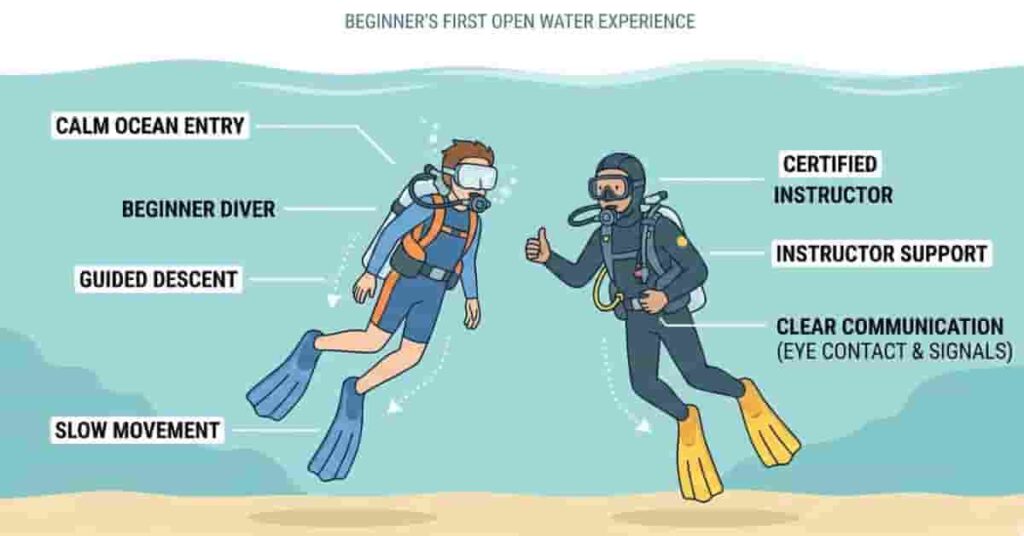
After completing the required confined-water training, you’ll complete supervised open-water dives. These dives help you apply your skills in a real diving environment.
Your instructor must assess your performance during practical sessions. They need to see that you can perform required skills safely and confidently.
Hands-on practice matters because scuba involves physical skills and equipment management. Watching a demonstration doesn’t guarantee you’ll perform the skill correctly underwater.
Pro Tip: Tell your instructor when you feel unsure about a skill. Extra practice can build confidence before your certification dives.
Hybrid Model Explained
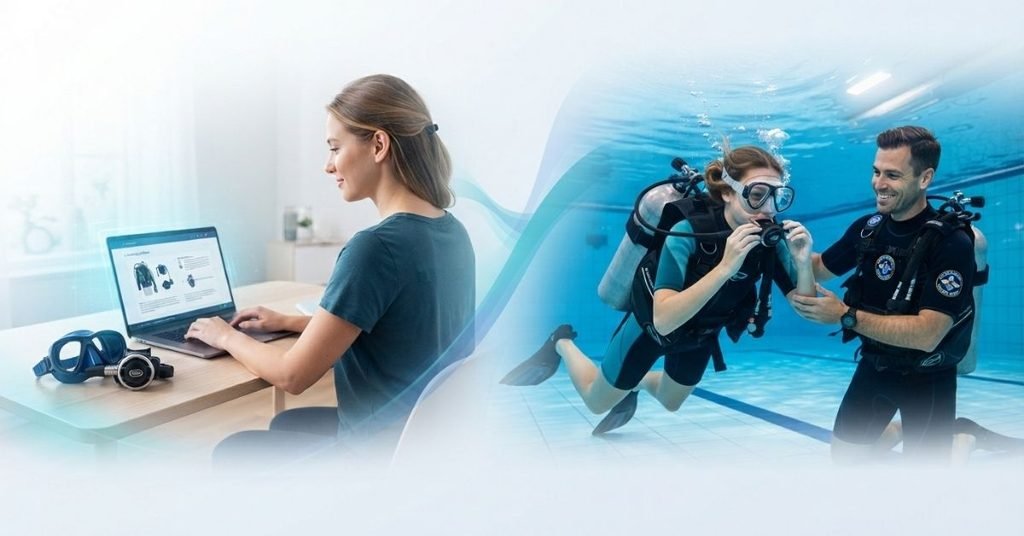
A hybrid scuba certification combines online theory with in-person water training. You complete academic lessons digitally, then meet an instructor for practical sessions.
This approach gives you more control over your study schedule. You can complete lessons at home instead of attending every classroom session at a dive center.
Once you finish the required online learning, you’ll schedule confined-water training. You’ll then complete the required supervised open-water dives with your instructor.
Major training organizations, including PADI and SSI, offer digital learning options that can support this hybrid approach. Exact requirements and course structures can vary by program and instructor.
Hybrid training can suit beginners who work full-time, attend school, or have limited free time. You can handle theory when it’s convenient and reserve specific days for practical training.
However, hybrid learning doesn’t mean you can skip instructor supervision. You still need proper in-water instruction and skills assessment before earning your certification.
Pros and Cons of Online Certification
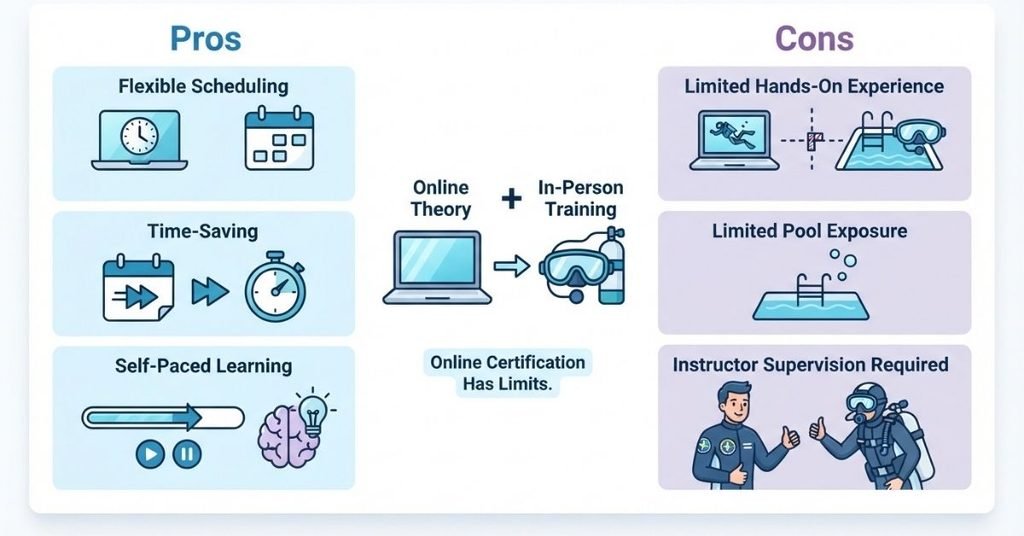
Online scuba learning makes certification more convenient, but it doesn’t replace practical training. Beginners should understand both the benefits and limitations before choosing this approach.
Pros
Flexible scheduling: You can study whenever your schedule allows. This works well around work, school, family, or travel.
Time-saving: Online theory can reduce the amount of classroom time you spend at a dive center. You can complete lessons before your practical sessions.
Learn at your own pace: You can pause, repeat, and review lessons until the concepts make sense. This can help beginners feel more prepared for pool training.
Cons
Less hands-on experience: Online lessons can’t teach physical skills like buoyancy control or mask clearing.
Limited pool exposure: You won’t gain practical experience until you attend in-water training. Don’t assume online completion means you’re ready to dive independently.
Not fully independent: A qualified instructor still needs to supervise practical training and assess required skills.
To reduce these limitations, choose a course with enough instructor-led water training. Ask questions whenever you’re unsure, and don’t rush through difficult lessons.
Safety Considerations for Online or Hybrid Courses
Online theory can prepare you for scuba diving, but in-water training remains essential for safety. Scuba requires physical skills that you must practice before diving independently.
Pool or confined-water sessions give you a controlled environment to learn essential techniques. Your instructor can watch your movements, correct mistakes, and help you become comfortable underwater.
Open-water training then lets you apply those skills in realistic conditions. Your instructor can assess how you manage equipment, buoyancy, communication, and common diving situations.
Pro Tips
Beginners can improve their safety by taking practical training seriously. Don’t treat the online portion as the entire certification process.
- Complete every required online lesson and assessment.
- Ask your instructor about anything you don’t understand.
- Practice each required skill until you feel comfortable.
- Never hide discomfort or anxiety during water sessions.
- Confirm all certification requirements before enrolling.
- Avoid schools promising certification without proper water training.
When choosing a hybrid course, check the dive school’s instructor credentials and certification agency. Ask where pool and open-water sessions occur and what the course includes.
Look for clear requirements, qualified instructors, proper equipment, and a structured training process. A reputable school should explain the complete pathway before you pay or enroll.
Conclusion
So, can I get scuba certified online? You can complete much of the theory online, but practical water training remains essential. Pool sessions and supervised open-water dives help you build the skills needed for safe diving.
Hybrid certification offers a convenient option for beginners with busy schedules. You can study at home while completing hands-on training with a qualified instructor.
You may also want to compare the overall cost of scuba certification before deciding which training option is right for you.
Choose a reputable dive school and understand its complete training requirements before enrolling. Don’t let online convenience replace proper practical instruction.
Ready to start your scuba journey? Explore our other beginner-friendly scuba guides to understand certification, training, and diving requirements. You can also share your experience or questions in the comments.
Frequently Asked Questions
No, you generally can’t complete an entry-level scuba certification entirely online. Online courses cover the academic portion, including safety, equipment, and dive planning. You still need hands-on confined-water training and supervised open-water dives. These sessions allow an instructor to assess your practical skills and underwater comfort. Be cautious of any program claiming you can earn a complete recreational certification without entering the water.
The online portion can take different amounts of time depending on the training agency and your learning pace. You may complete lessons in several sessions or spread them across multiple days. The course usually includes knowledge reviews and assessments. Remember that finishing online academics doesn’t complete your certification. You still need the required pool and open-water training. For the complete timeline, see our guide on How Long to Be Scuba Certified?
Certification from major recreational scuba agencies is widely accepted by dive operators in many destinations. However, acceptance can depend on the operator, location, certification level, and local requirements. Always confirm requirements before booking a dive trip. A hybrid course doesn’t automatically mean lower-quality training. What matters is completing the agency’s required knowledge, confined-water, and open-water training.
Yes, beginners can use hybrid courses when they complete all required practical training with a qualified instructor. Online lessons provide the academic foundation, while pool sessions develop essential physical skills. Supervised open-water dives then help you apply those skills in real conditions. Take your time, ask questions, and tell your instructor when you need more practice.
Online lessons typically introduce important diving concepts before your practical sessions. Topics may include equipment, pressure, buoyancy, safety procedures, communication, and dive planning. Quizzes or knowledge assessments help confirm your understanding. The exact curriculum varies by certification agency and course. You should complete the required academic material before moving to the practical training stage.
Yes. Online learning doesn’t replace an instructor for the practical portion of certification. A qualified instructor teaches and evaluates essential underwater skills during confined-water and open-water training. They can also correct mistakes and help you become more comfortable in the water. This supervision is an important part of learning to dive safely.
Online training can be a convenient option for beginners who prefer flexible study. You can review lessons at your own pace and complete the academic portion from home. However, you should treat online learning as one part of the certification process. Make sure your course includes proper instructor-led water training before considering yourself ready to dive independently.
Check which certification agency provides the course and who will conduct your practical training. Confirm the number and type of confined-water and open-water sessions included. Ask about instructor qualifications, equipment, training locations, and additional practice if needed. A reputable dive school should clearly explain the complete certification process before you enroll.
No. Completing online academics doesn’t demonstrate that you can perform essential scuba skills underwater. Confined-water training gives you a controlled environment to practice those skills with an instructor. You’ll need to complete the practical requirements set by your certification program. Online lessons prepare you for the water, but they don’t replace water-based skill development.

Scuba Diving Researcher & Beginner Guide
Evan Calder is the creator of DiveBeginner, a website dedicated to helping beginners learn scuba diving simply and practically 🌊
He focuses on scuba fundamentals, beginner safety, and clear diving guidance. Evan has studied ocean and marine science through programs at the Scripps Institution of Oceanography, UC San Diego, a globally recognized leader in ocean research.
Instead of complex technical language, Evan provides easy-to-follow, beginner-friendly guides based on real-world research, helping first-time divers feel confident before their first dive 🤿
DiveBeginner reflects his passion for making scuba diving accessible, safe, and enjoyable for everyone.