Table of Contents
Introduction
Can I get scuba certified in one day, or does certification always take several days?
If you have a short vacation planned, this question can feel especially important. Many beginners want to learn scuba diving without spending their entire trip in training.
The good news is that several training options can make the process faster. However, a full certification involves more than simply getting into the water. You need to complete knowledge development, practice essential skills, and meet open-water training requirements.
This guide explains what you can realistically complete in one day. You’ll also learn how fast-track courses and referral programs can shorten your schedule. We’ll compare intensive training with a typical scuba certification timeline.
If you’re considering a fast certification schedule, first learn how to become scuba certified and what the full training process includes.
By the end, you’ll know how many days it takes to get scuba certified and which option may fit your plans. Most importantly, you’ll understand why learning the required skills matters more than rushing through the course.
Can I Get Scuba Certified in One Day?
Can I get scuba certified in one day? For most beginners, a full entry-level scuba certification usually cannot fit into a single day. Certification requires more than learning basic equipment use. You must complete the required knowledge, practical skills, and open-water training for your course.
The phrase “certified in one day” can also mean different things. A dive center might offer one day of training without completing the entire certification. Another program may use an accelerated schedule, especially when you finish online theory beforehand. A referral program can also reduce the training needed at your destination.
Your timeline depends on the training agency, instructor, dive center, weather, and water conditions. Previous scuba training can also change how much work remains. Always confirm the exact course requirements before booking a fast-track program.
Can a Complete Beginner Get Certified in One Day?
For a complete beginner, earning a full scuba certification in one day is generally unrealistic. You need time to understand diving theory and practice essential skills under proper supervision.
Confined-water training helps you become comfortable with your equipment and basic scuba skills. Open-water training then lets you demonstrate those skills in a real diving environment. These stages serve different purposes and shouldn’t be rushed simply to meet a tight schedule.
A fast course can work well for some prepared students. However, speed should never replace proper practice or skill mastery. If you struggle with buoyancy, equalization, equipment use, or emergency skills, taking additional training time is the safer choice.
What Can You Realistically Complete in One Day?
Depending on the program, you may be able to complete several parts of your scuba training within one day:
- Online theory: Complete knowledge development before or during your trip.
- Pool training: Practice essential skills in confined water with an instructor.
- Introductory scuba: Try scuba diving without completing a full certification course.
- Accelerated training: Complete an intensive portion of a certification program.
- Referral training: Finish eligible training requirements before completing the remaining dives elsewhere.
The key difference is that one day of training doesn’t always equal one day to full certification. Ask the dive center exactly which requirements you’ll complete before booking.
How Many Days Does It Take to Get Scuba Certified?
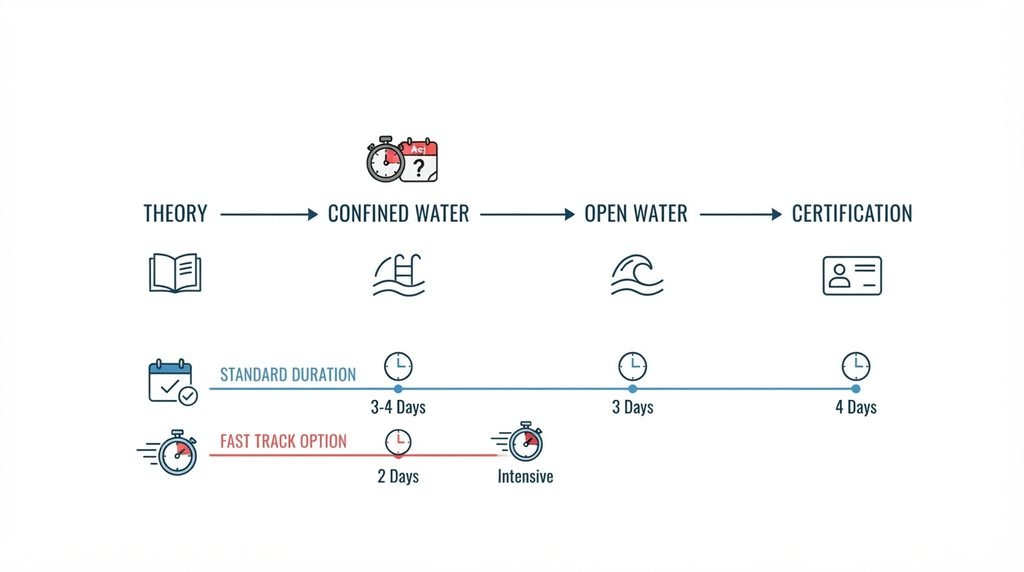
How many days does it take to get scuba certified? For most beginners, the answer depends on the course format and how quickly you complete each training stage. Some students may finish their training on a compact schedule, while others need more time for practice and comfort.
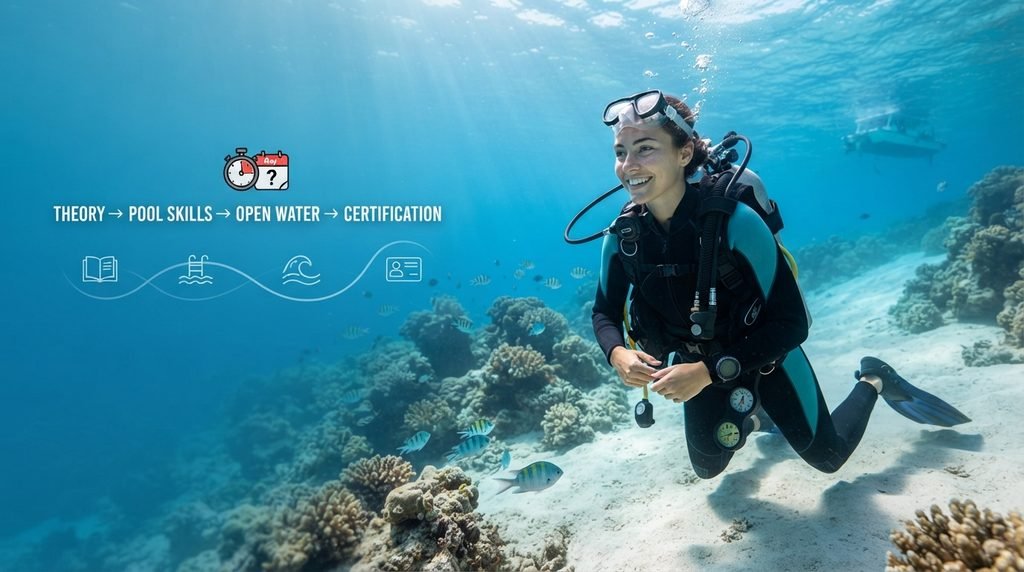
Scuba certification typically includes knowledge development, confined-water training, open-water dives, and instructor evaluation. Each stage prepares you for the next one, so completing the course isn’t simply about counting calendar days.
Your timeline can also change because of weather, water conditions, instructor availability, and your own progress. A student who needs extra practice may take longer, while someone who completes theory beforehand may reduce their in-person training time.
The course format matters too. Standard courses, accelerated programs, and referral options can follow different schedules. Before booking, ask the dive center exactly what you’ll complete each day and which requirements remain.
Typical Beginner Certification Timeline
There isn’t one universal timeline for every beginner. Use this table as a general guide rather than a fixed schedule.
| Training Stage | What Happens | Typical Timing |
|---|---|---|
| Theory | Learn diving knowledge, safety, and basic principles | Before or during the course |
| Confined Water | Practice essential scuba skills with an instructor | Course-dependent |
| Open Water | Apply learned skills during actual dives | Course-dependent |
| Certification | Instructor confirms all course requirements are met | After required training |
Some courses let you complete theory online before arriving. That can make your in-person schedule more efficient, but it doesn’t replace practical training.
Pro Tip: Ask your dive center for a day-by-day schedule before booking. Confirm which training components are included and what happens if weather delays an open-water session.
What Does Scuba Certification Involve?
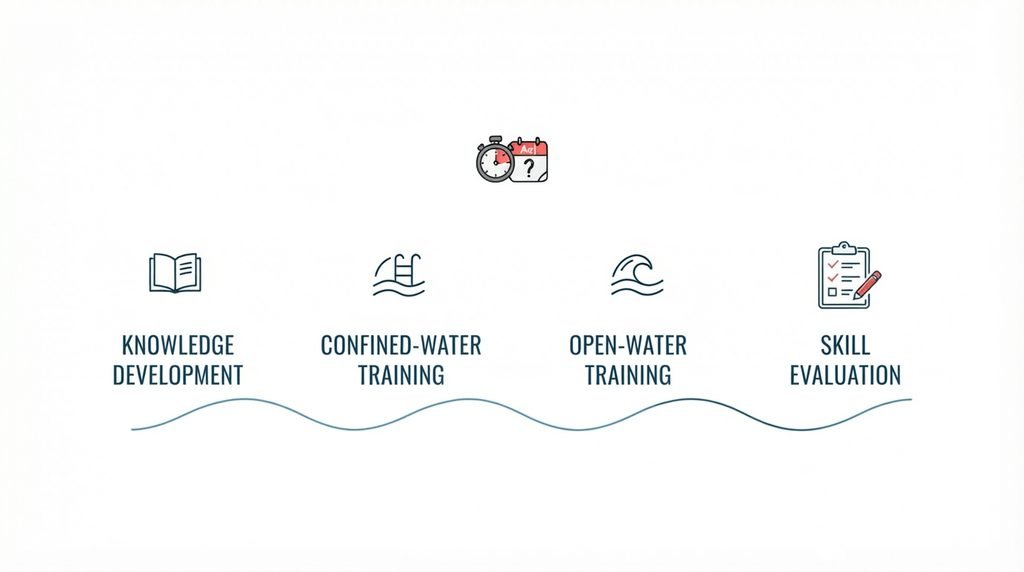
Scuba certification involves several stages that build your knowledge, skills, and confidence underwater. That’s why beginners shouldn’t treat certification as a race to finish in one day.
You need to understand diving concepts before practicing them. You then practice essential skills in controlled water before demonstrating them during open-water dives.
Your age can also affect which training options are available, so check the minimum age for scuba certification before enrolling.
Scuba Theory and Knowledge Development
Theory gives you the foundation needed to make safe decisions underwater. You learn how pressure affects your body, how scuba equipment works, and how to plan dives.
Key topics commonly include:
- Diving physics and pressure
- Scuba equipment and its proper use
- Basic safety procedures
- Dive planning and air management
- Equalization techniques
- Decompression awareness
- Emergency procedures
Many programs offer online knowledge development, while others use classroom instruction. Online learning can make your schedule more flexible, but it doesn’t replace practical training.
Understanding the theory also helps you recognize problems before they become emergencies. For beginners, this knowledge becomes especially important when conditions change during a dive.
Confined-Water Training
Confined-water sessions let you practice scuba skills in a controlled environment. Your instructor can watch your technique and help you correct mistakes before open-water training.
You may practice equipment setup, regulator use, mask skills, buoyancy control, and underwater communication. Training can also include emergency skills and controlled ascents and descents.
Repetition matters because beginners need time to become comfortable underwater. Practicing a skill once doesn’t always mean you can perform it calmly when conditions become challenging.
Good buoyancy control is one example of a skill that improves through repeated practice. Taking extra time to build confidence can make the next training stage much easier.
Open-Water Training Dives
Open-water training takes your practiced skills into an actual diving environment. Your instructor evaluates how you apply those skills while managing real underwater conditions.
You may encounter changing visibility, currents, depth, water temperature, or other environmental factors. These conditions require you to use the knowledge and skills developed during earlier training.
Required dives and skills cannot simply be skipped to save time. Certification depends on demonstrating the required abilities safely and following the applicable course standards.
Pro Tip: Don’t judge your progress by how quickly you finish each session. Focus on performing every required skill correctly and confidently before moving forward.
Can Fast-Track Scuba Certification Be Completed Quickly?
Fast-track scuba certification uses an intensive schedule to complete required training in less time. It can suit travelers with limited vacation time, but it doesn’t remove required learning or practical skills.
If time is your main concern, comparing the typical scuba certification timeline can help you understand what can realistically be completed in one day.
Many programs let students complete theory before arriving. This approach leaves more time for confined-water practice and open-water training during the trip. Some dive centers may schedule multiple sessions close together, depending on their course structure and local conditions.
The key point is simple: fast-track doesn’t mean skipping training. You still need to complete the applicable knowledge, skill, and open-water requirements. Your instructor must also confirm that you can perform the required skills safely.
How Fast-Track Certification Works
An accelerated course may follow this general progression:
- Complete knowledge development: Finish the required theory before or during your course.
- Attend confined-water training: Practice essential scuba skills under instructor supervision.
- Complete required open-water training: Apply those skills in an actual diving environment.
- Demonstrate required skills: Show your instructor that you can perform the course skills properly.
- Receive certification: Certification follows after you meet the applicable course requirements.
The exact schedule varies by certification agency, dive center, instructor, and conditions. Some students may need additional practice before moving forward.
Who Is a Good Candidate for Fast-Track Training?
Fast-track training may work well for students who prepare carefully and handle an intensive schedule comfortably. Completing theory beforehand can also reduce the amount of work during the trip.
Good candidates may include:
- Prepared students who understand the course expectations
- Travelers with limited vacation schedules
- Students comfortable with intensive learning
- People who can complete theory before arriving
- Students who can demonstrate all required skills safely
Your ability to learn and perform skills matters more than your preferred completion date.
When Fast-Track Training May Not Be a Good Idea
An accelerated schedule isn’t ideal for everyone. Beginners may need additional time when learning unfamiliar equipment, underwater skills, or emergency procedures.
Consider slowing down if you experience:
- High stress or anxiety
- Difficulty learning basic scuba skills
- Physical or mental fatigue
- Trouble equalizing
- Poor weather or water conditions
- Pressure to finish before you’re ready
Pro Tip: Tell your instructor when you need more practice. A longer training schedule is better than rushing through skills you haven’t mastered.
What Is a Scuba Referral Program?
A scuba referral program lets you complete part of your certification training before traveling. You can then finish the remaining requirements with another instructor or dive center at your destination.
This option can work well if you have limited vacation time. For example, you might complete knowledge development and confined-water training near home. You would then travel to a dive destination and complete the required open-water training there.
A referral can make the destination portion of certification much shorter. However, it doesn’t mean you become fully certified after one day. You still need to complete every applicable requirement and demonstrate the required skills.
The exact process depends on your certification agency and the dive centers involved. Before traveling, confirm which training you can complete locally and which requirements remain at your destination.
Can a Referral Make Scuba Certification Faster?
Yes, a referral can reduce the amount of certification training you need to complete during your trip. The main advantage comes from dividing the course between two locations.
You may complete eligible theory and practical training before leaving home. A participating instructor at your destination can then complete the remaining training according to the applicable course standards.
This approach can be especially useful for travelers who want to minimize training days during a vacation. However, you shouldn’t assume every dive center accepts every referral arrangement.
Pro Tip: Before booking travel, ask both instructors to confirm your referral paperwork, completed requirements, and remaining training. This helps prevent unexpected delays at your destination.
What Do PADI, SSI, and Other Certification Agencies Require?
Major recreational scuba agencies set standards for their certification courses. PADI and SSI are two widely used training organizations, but their course structures and requirements can differ.
For beginners, the important point is that certification involves more than online learning. You must complete the applicable academic work, practical skills, and open-water training. Your instructor must also confirm that you meet the course requirements before certification.
PADI Certification Requirements
The PADI Open Water Diver course has three main phases: knowledge development, confined-water training, and open-water dives. PADI also describes the course as performance-based, meaning students progress after demonstrating the required knowledge and skills.
Knowledge development covers diving principles, equipment, planning, and safety. Students then practice essential skills in a pool or similar confined-water environment.
The final phase involves open-water training dives. PADI currently states that its Open Water Diver course includes four open-water dives. These dives allow students to apply their skills in an actual diving environment.
SSI Certification Requirements
SSI’s Open Water Diver program also combines academic learning with confined-water and open-water training. Its current standards require students to complete the academic sections and assessments, confined-water sessions and skill evaluations, and at least four open-water training dives.
SSI also supports digital learning through its MySSI system. This allows students to access training materials online and prepare before their practical sessions.
The instructor still needs to evaluate the required practical skills. Completing online material alone doesn’t make someone an independently certified open-water diver.
Can Agency Requirements Be Completed Online?
Some theory can be completed online, but practical scuba training cannot be replaced by online learning. PADI offers eLearning for knowledge development, while SSI provides digital training through its platform.
Online learning can save time during your trip because you can study before arriving. However, you still need the applicable confined-water practice, open-water training, and skill evaluations.
Exact requirements and course schedules can change between agencies and training centers. Always check the current agency standards and confirm the schedule with your instructor before booking.
Pro Tip: Ask the dive center which requirements you can complete before your trip. This helps you understand exactly how much in-person training remains.
Is One-Day Scuba Certification Safe?
The safety of scuba certification isn’t determined by the number of calendar days alone. What matters most is whether you understand the knowledge and can demonstrate the required skills safely.
A fast-track course may compress training into a tighter schedule. However, rushing can create problems if you need more time to practice or understand a skill.
Your instructor should evaluate your performance throughout the course. If you haven’t mastered a required skill, finishing quickly shouldn’t become the priority. Taking additional time can help you build confidence and respond more effectively underwater.
Problems With Rushing Scuba Training
Compressing too much learning into a short period can make training more demanding. Beginners may experience information overload, fatigue, and increased stress.
You may also have less time to repeat unfamiliar skills. That can affect skill retention and make it harder to respond calmly when something unexpected happens.
Common concerns include:
- Too much information to absorb at once
- Physical or mental fatigue
- Poor retention of newly learned skills
- Increased stress or anxiety
- Not enough time for skill repetition
- Difficulty responding automatically during an emergency
Scuba skills should become familiar through proper practice. A rushed schedule can make that process harder for some beginners.
How to Make Fast-Track Training Safer
You can prepare before your course to make an intensive schedule more manageable. Completing theory beforehand can reduce the amount of information you need to study during practical training.
Try these steps:
- Complete available theory before arriving.
- Get adequate sleep before training sessions.
- Ask your instructor questions when something isn’t clear.
- Repeat difficult skills until you feel comfortable.
- Tell your instructor about discomfort or anxiety.
- Choose a qualified instructor and reputable dive center.
- Focus on mastering skills rather than finishing quickly.
Good preparation can make fast-track training smoother. However, preparation doesn’t mean you should ignore problems or push beyond your comfort level.
When Should You Slow Down?
You should consider taking more time when you cannot comfortably perform required skills. Feeling overwhelmed or exhausted can also be a reason to pause and reassess your pace.
Pay particular attention if you:
- Struggle to perform required skills correctly
- Feel overwhelmed or unusually fatigued
- Have persistent difficulty equalizing
- Don’t understand emergency procedures
- Need additional practice recommended by your instructor
Pro Tip: Be honest with your instructor about anything that feels difficult. Asking for more practice is a sign of good judgment, not failure.
One-Day vs Typical Scuba Certification Timeline
A one-day or intensive course compresses training into a much tighter schedule. A typical course gives beginners more time to learn, practice, and build confidence between sessions.
The biggest difference isn’t simply the number of days. It’s how much learning and practice you complete within that time. An intensive course may require more preparation before you arrive.
| Factor | One-Day / Intensive Approach | Typical Course |
|---|---|---|
| Learning pace | Very fast | More gradual |
| Theory | Often completed beforehand | Spread across the course |
| Practice | Limited time | More repetition |
| Fatigue | Potentially higher | Usually easier to manage |
| Flexibility | Lower | Higher |
| Weather delays | More disruptive | More scheduling flexibility |
| Beginner-friendly | Usually less ideal | Generally better |
| Skill practice | Compressed | More opportunities |
Why a Typical Course May Work Better for Beginners
Faster doesn’t automatically mean better. Beginners often need time to absorb diving concepts and repeat unfamiliar skills.
A normal course can provide more opportunities to practice equipment use, buoyancy, communication, and emergency procedures. It can also give your instructor more time to identify areas that need improvement.
An intensive schedule may suit a well-prepared student with limited travel time. However, your learning pace, comfort level, and course structure should guide the decision.
Pro Tip: Compare the actual training schedule rather than choosing based only on the advertised number of days. Ask what happens if you need extra practice or weather interrupts open-water training.
What Can I Do If I Only Have One Day?
If you only have one day available, you still have ways to experience scuba diving. The best option depends on whether you want to try scuba or actually complete certification.
A full certification may not fit your schedule, but you can prepare before your trip. You can also choose an introductory experience or use a referral arrangement to reduce the training needed at your destination.
Try an Introductory Scuba Experience
An introductory scuba experience lets beginners try scuba diving without completing a full certification course. You receive basic instruction and dive under the direct supervision of a qualified professional.
This can be a good choice if you’re visiting a dive destination for only one day. It lets you experience breathing underwater and learn basic scuba techniques without rushing through a full certification program.
However, an introductory experience isn’t the same as becoming a certified diver. You generally cannot treat it as a replacement for the training required to dive independently as a certified diver.
Complete Theory Before Your Trip
If you plan to pursue certification, completing available theory beforehand can save valuable time. Many certification programs offer online knowledge development that you can complete before traveling.
This approach reduces classroom time at your destination. You can then focus more of your available time on practical training and skill development.
Online theory doesn’t replace confined-water or open-water requirements. You still need to complete the applicable practical training and demonstrate the required skills.
Use a Referral Program
A referral program can divide your certification training between your home area and your travel destination. You may complete eligible training before leaving and finish the remaining requirements with another participating dive center.
This can significantly reduce the training time needed during your trip. However, confirm the referral arrangements with both instructors before traveling.
Plan Certification Across Several Days
For complete beginners, spreading certification across several days is usually the most straightforward approach. It gives you more time to understand the material, practice skills, and become comfortable underwater.
A longer schedule also provides room for rest and unexpected weather or water-condition changes. Instead of focusing only on finishing quickly, you can focus on becoming a confident and capable diver.
Conclusion
So, can I get scuba certified in one day? For most complete beginners, a full certification usually needs more time. You must complete theory, practical skills, open-water training, and instructor evaluation.
Fast-track courses and referral programs can reduce the time spent at your destination. Completing theory before your trip may also make your schedule more efficient. However, faster training doesn’t mean skipping required skills or rushing your learning.
If you’re wondering how many days it takes to get scuba certified, ask your dive center for a clear day-by-day schedule. Choose a pace that gives you enough time to learn and practice safely.
Planning a scuba trip? Share your experience or questions in the comments. Then explore our other beginner scuba guides for more helpful tips.
FAQs About One-Day Scuba Certification
For most beginners, you shouldn’t expect to complete a full scuba certification in one day. Certification includes knowledge development, confined-water skills, open-water training, and skill evaluation. Some accelerated programs can compress the schedule, but they still require you to complete the applicable training requirements.
A complete beginner generally needs more time to become comfortable with scuba skills. You must learn the theory, practice essential skills, and demonstrate them during open-water training. Rushing these steps can make learning harder, while a longer schedule provides more opportunities to practice and build confidence.
There is no single timeline that applies to every student. Course length depends on the certification agency, training format, instructor, location, and student progress. Completing theory beforehand can shorten your in-person schedule, while weather and water conditions can affect open-water training.
The required number of dives depends on the specific certification course and training agency. Some entry-level programs require four open-water training dives. Always check the current requirements for your chosen course before booking.
Yes, many certification programs offer online knowledge development. You can learn topics such as diving principles, equipment, safety, and dive planning before your practical sessions. Online theory does not replace confined-water practice, open-water training, or required skill evaluations.
Fast-track certification can be appropriate when you complete all required training and demonstrate the necessary skills. Speed alone doesn’t determine whether a course is safe. Your instructor should confirm that you’re ready before moving forward, and you should never rush a skill to meet a schedule.
A scuba referral lets you complete eligible certification training with one instructor before traveling. You then finish the remaining requirements with another participating dive center. This can reduce your destination training time, but you aren’t fully certified until all required training is completed.
You can often try scuba through an introductory experience under professional supervision. These experiences let beginners explore scuba without completing a full certification course. However, they aren’t the same as being a certified diver, and independent recreational diving generally requires appropriate certification and training.

Scuba Diving Researcher & Beginner Guide
Evan Calder is the creator of DiveBeginner, a website dedicated to helping beginners learn scuba diving simply and practically 🌊
He focuses on scuba fundamentals, beginner safety, and clear diving guidance. Evan has studied ocean and marine science through programs at the Scripps Institution of Oceanography, UC San Diego, a globally recognized leader in ocean research.
Instead of complex technical language, Evan provides easy-to-follow, beginner-friendly guides based on real-world research, helping first-time divers feel confident before their first dive 🤿
DiveBeginner reflects his passion for making scuba diving accessible, safe, and enjoyable for everyone.