Table of Contents
Introduction
How long should you stay underwater, and when is the safest time to dive?
Understanding scuba dive timing can make every underwater adventure safer and more enjoyable. For beginners in the USA, dive duration can seem confusing at first. Your depth, air supply, experience, and dive conditions all affect how long you can stay underwater.
Knowing the average scuba dive time helps you plan your dive without guessing. It also helps you understand when to end a dive and return safely. The best time to scuba dive can also vary based on weather, visibility, currents, and the location.
In this guide, you’ll learn how depth, tank size, breathing rate, and equipment affect dive time. We’ll also explain multiple dives, surface intervals, rebreathers, and flying after diving. You’ll discover how extreme-depth dives differ from normal recreational diving.
By the end, you’ll have a clear understanding of dive times, depth limits, and essential safety practices. This guide will help you plan smarter and dive with greater confidence.
If you’re planning a trip to Southeast Asia, our guide explains the best time to scuba dive in Thailand by region and dive site.
Average Scuba Dive Time
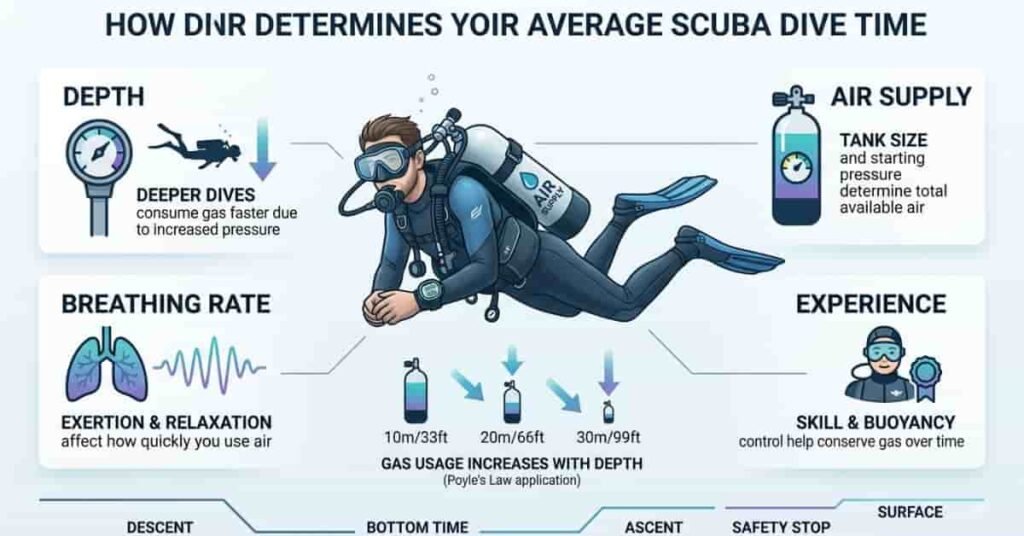
The average scuba dive time depends on several factors, not just the amount of air in your tank. Depth, breathing rate, experience, water conditions, and your dive plan all affect your bottom time. Deeper dives use gas faster because surrounding water pressure increases with depth.
Beginners often spend less time underwater while they build breathing control and comfort. Experienced divers may stay underwater longer when conditions and their dive plan allow it. However, experience does not automatically mean you should extend a dive.
Your tank size also matters. An 80 cu ft tank can provide a useful amount of gas for recreational diving, but actual duration varies widely. A diver who breathes heavily may use the same tank much faster than a relaxed diver. Always follow your gas plan and keep an appropriate reserve.
For tropical diving in the South Pacific, learn about the best time to scuba dive in Fiji and what conditions to expect.
What Determines Dive Duration?
Several factors work together to determine how long a dive can safely last:
- Depth: Greater depth increases gas consumption.
- Air supply: Larger tanks can provide more available gas.
- Breathing rate: Calm, efficient breathing generally reduces gas use.
- Experience: Practice can improve buoyancy and breathing control.
- Workload: Swimming against currents can increase air consumption.
- Dive limits: Your training, dive computer, and planned profile matter.
There is no single safe dive time for every diver. Plan each dive around your actual gas supply, depth, conditions, and training.
Best Time of Day to Scuba Dive
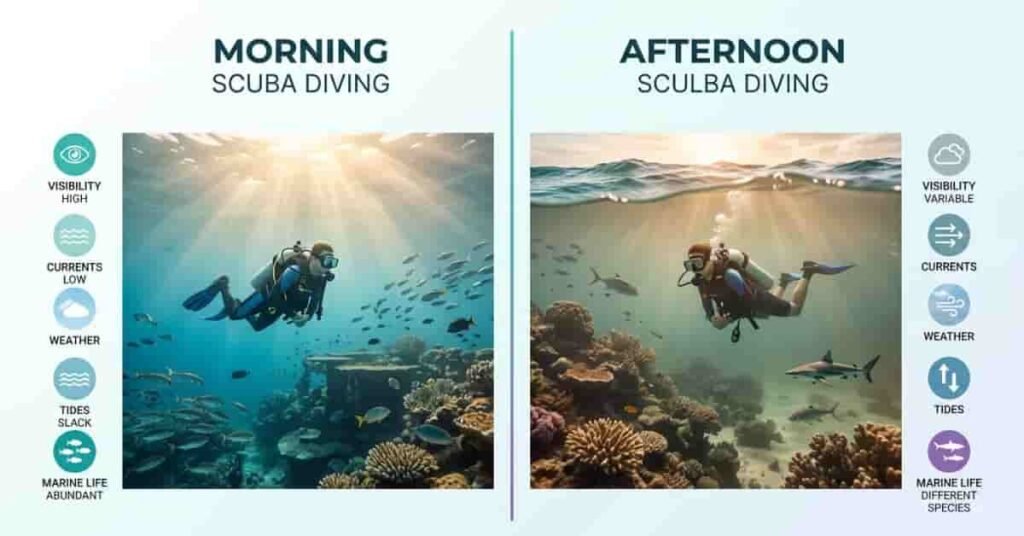
The best time of day to scuba dive depends on local conditions, your dive site, and the type of experience you want. Morning and afternoon dives can both offer excellent underwater conditions.
Morning dives often provide favorable conditions at many tropical locations. Winds may be lighter, and water conditions can sometimes remain calmer. Visibility also depends on recent weather, currents, boat traffic, and local conditions.
Afternoon dives can still provide excellent visibility and marine-life encounters. Some species become more active later in the day. However, conditions can change quickly, especially at exposed coastal sites.
Before choosing a dive time, check the local forecast, tide information, current conditions, and operator recommendations. Your dive professional can also explain how conditions typically change throughout the day.
If you’re considering the Caribbean, check our guide to the best time to scuba dive in Belize before choosing your travel dates.
Morning vs. Afternoon Dives
Morning dives may offer:
- Calmer surface conditions at some locations
- Fresh conditions before afternoon weather changes
- Good visibility when local conditions support it
Afternoon dives may offer:
- Different marine-life activity
- Warmer surface conditions in some locations
- Convenient scheduling for travelers
There’s no universal “best” time for every dive site. Choose the time that matches local conditions, your experience, and the planned dive.
Pro Tip: Ask a local dive operator when visibility, currents, and marine activity are usually most favorable. Local experience can be more useful than a general time-of-day rule.
Best Time to Scuba Dive
The best time to scuba dive depends heavily on the destination, season, water temperature, visibility, and weather. There is no single month that works well for every dive location. Conditions can change between regions, even within the same country.
Tropical destinations may offer warm water for much of the year. However, rainy seasons, storms, currents, or reduced visibility can affect diving conditions. Temperate destinations usually have stronger seasonal changes, with water temperature and marine life varying throughout the year.
When choosing a dive season, research the specific destination rather than relying on a global rule. Check local weather patterns, water temperatures, seasonal visibility, and marine-life activity.
For example, one destination may offer its clearest water during a dry season. Another may have better wildlife encounters during a particular migration period. Local dive operators can provide valuable guidance about current conditions.
Pro Tip: Create destination-specific internal links for locations such as Belize, Fiji, or the Maldives. Each guide can explain its ideal diving months and seasonal conditions.
Old Time Scuba Diver Insights
An old time scuba diver would recognize how dramatically diving equipment has changed. Early divers relied on heavier equipment, simpler breathing systems, and techniques that required careful planning. Modern divers now benefit from advanced regulators, buoyancy systems, dive computers, and specialized breathing equipment.
Early diving methods included surface-supplied systems and basic compressed-air equipment. The development of the modern demand regulator helped make independent scuba diving more practical. Jacques-Yves Cousteau and Émile Gagnan played an important role in developing the Aqua-Lung during the 1940s.
Diving technology continued to evolve through improved regulators, buoyancy compensators, depth gauges, and decompression planning. Dive computers later made it easier to monitor depth and time during recreational dives.
From Early Gear to Modern Equipment
Older equipment often required more physical effort and careful manual monitoring. Today’s equipment gives divers more information while underwater.
However, technology does not replace training or sound judgment. Divers still need proper certification, equipment checks, and conservative dive planning.
Expert Tip: Treat historical diving records as lessons in equipment development, not examples to copy. Modern recreational divers should stay within their training and equipment limits.
cuba Rebreather Dive Time
Scuba rebreather dive time can exceed the practical duration of many open-circuit dives, but rebreathers do not remove normal diving limits. A rebreather recycles exhaled gas instead of releasing each breath as bubbles. The system removes carbon dioxide and manages oxygen levels within the breathing loop.
Open-circuit scuba releases exhaled gas into the water. Your cylinder supply therefore decreases with every breath. A rebreather can reuse much of the breathing gas, which can reduce gas wastage and extend underwater endurance.
However, longer gas duration does not automatically mean a diver can safely stay deeper or longer. Oxygen exposure, decompression requirements, carbon dioxide management, scrubber capacity, and equipment condition still matter.
Open-Circuit vs. Rebreather Diving
| Feature | Open-Circuit Scuba | Rebreather |
|---|---|---|
| Exhaled gas | Released into water | Recycled |
| Visible bubbles | Yes | Usually minimal |
| Gas efficiency | Lower | Higher |
| Equipment complexity | Lower | Higher |
| Specialized training | Required | Additional training required |
Rebreather divers need unit-specific training and detailed pre-dive checks. They also learn bailout procedures and responses to oxygen or equipment problems.
Safety Tip: Never treat a rebreather as simply a longer-lasting scuba tank. Follow your training, manufacturer procedures, dive plan, and equipment limits.
The Deepest Scuba Dive of All Time
The deepest scuba dive of all time reached a remarkable depth of 332.35 meters (1,090 feet). Egyptian diver Ahmed Gabr completed the record dive in the Red Sea near Dahab on September 18, 2014. Guinness World Records lists this as the deepest scuba dive in seawater.
Gabr’s dive required extensive preparation and specialized technical diving equipment. Guinness reports that he had spent 17 years as a diving instructor before attempting the record. His dive surpassed the previous record of 318.25 meters set by Nuno Gomes in 2005.
Extreme-depth diving creates serious physiological challenges. Water pressure rises dramatically with depth, affecting breathing gases and equipment performance. Divers also face complex decompression requirements and increased gas-management demands.
These record dives have little connection to normal recreational scuba diving. Recreational divers should follow their certification limits and use appropriate equipment and training.
Why Extreme Depth Is So Challenging
At extreme depths, divers must manage:
- Very high surrounding pressure
- Complex breathing-gas requirements
- Long decompression schedules
- Equipment reliability
- Gas supply and emergency reserves
- Potential oxygen and inert-gas effects
How Long Should You Wait Before Flying After Scuba Diving?
The phrase aviation scuba dive wait time refers to the surface interval needed before traveling to altitude after diving. Flying too soon after a dive can increase decompression stress because aircraft cabins operate at lower pressure than sea level.
Divers Alert Network (DAN) recommends a minimum 12-hour surface interval after a single no-decompression dive. After multiple dives in one day or diving across multiple days, DAN recommends at least 18 hours. Dives requiring decompression stops call for a substantially longer interval.
These recommendations reduce risk but do not guarantee that decompression sickness will not occur. Waiting longer provides an additional safety margin.
Flying After Diving: Basic Guidelines
| Dive profile | Minimum recommended interval |
|---|---|
| Single no-decompression dive | 12 hours |
| Multiple dives or multiple dive days | 18 hours |
| Decompression dive | Substantially longer than 18 hours |
PADI also advises a more conservative 24-hour surface interval as a general recommendation after diving.
Your dive computer may display a specific no-fly time. Follow the more conservative instruction when it differs from general guidelines.
Safety Tip: Never fly if you develop symptoms that could indicate decompression sickness. Seek appropriate medical advice before traveling.
How Many Times Can You Scuba Dive in One Day?
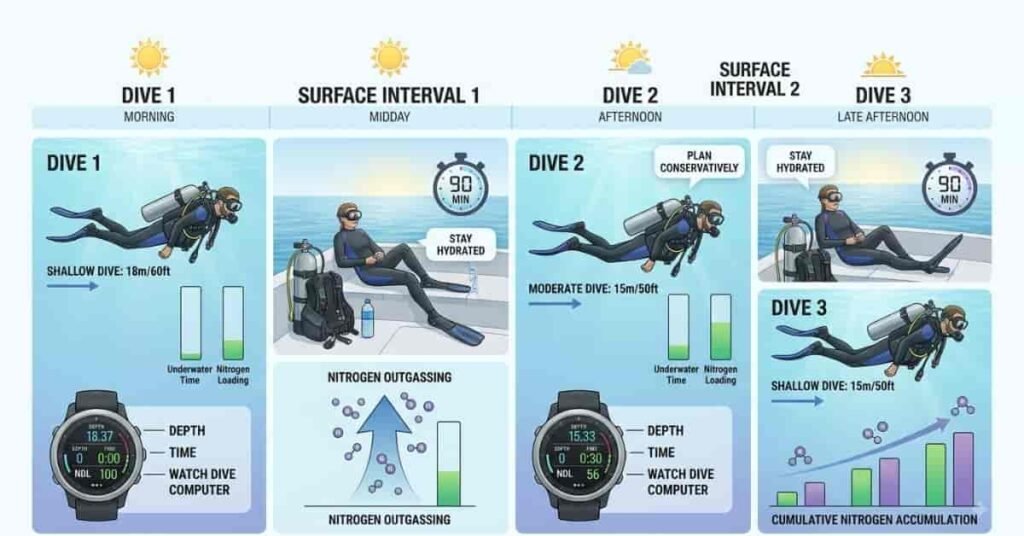
There is no universal number of dives that every diver can safely complete in one day. The answer depends on your certification, dive profiles, surface intervals, gas supply, and physical condition. Your dive computer can help track nitrogen exposure and no-decompression limits throughout the day.
Many recreational divers complete two dives in one day, while some operators offer three or more. More dives increase cumulative nitrogen exposure, so each additional dive requires careful planning. You should also consider depth, bottom time, water temperature, currents, and workload.
How to Space Multiple Dives
Allow enough time between dives for your body to eliminate some absorbed inert gas. A longer surface interval can provide a greater safety margin, especially after deeper dives.
For repetitive dives, consider:
- Follow your dive computer’s surface-interval guidance.
- Plan deeper dives before shallower dives when appropriate.
- Stay within your training and no-decompression limits.
- Monitor your air supply throughout every dive.
- Avoid diving when unusually tired or unwell.
- Follow your dive operator’s schedule and procedures.
80 Cu Ft Scuba Tank Dive Time
The 80 cu ft scuba tank dive time depends on much more than the cylinder’s capacity. Your depth, breathing rate, activity level, and planned gas reserve can change the actual duration significantly.
An 80 cu ft cylinder contains a nominal volume of 80 cubic feet of gas when filled to its rated pressure. As you descend, surrounding pressure increases. Your regulator supplies gas at the surrounding pressure, so you consume gas faster at greater depths.
A simple planning concept uses your surface air consumption rate and the absolute pressure at depth:
Gas consumption at depth ≈ surface consumption × absolute pressure
For example, assume a diver has a hypothetical surface consumption rate of 0.5 cu ft per minute. At approximately 33 feet of seawater, pressure is about 2 atmospheres absolute. The estimated consumption would be about 1.0 cu ft per minute.
An 80 cu ft cylinder would therefore appear to provide about 80 minutes under those simplified conditions. However, that does not mean the diver should use the entire cylinder.
What Changes Tank Duration?
- Depth: Greater depth increases gas consumption.
- Breathing rate: Higher rates shorten available time.
- Exercise: Hard swimming increases breathing demand.
- Water conditions: Currents can increase workload.
- Tank pressure: Actual usable gas depends on the cylinder’s fill pressure.
- Reserve: Divers must keep gas available for the planned ascent and emergencies.
Best Scuba Computers for Dive Time Monitoring
Choosing among the best scuba computers for dive time depends on your experience, diving style, and desired features. A good computer should make important information easy to understand underwater.
Popular options include the Garmin Descent series, Shearwater Research computers, and models from Suunto. Each brand offers computers designed for different levels of diving.
Garmin Descent Series
Garmin’s Descent line combines dive functions with smartwatch and fitness features.
Pros:
- Dive computer and smartwatch functions
- Multiple dive modes on selected models
- Strong display and navigation features
Cons:
- Advanced models can cost more
- Many features may exceed a beginner’s needs
Shearwater Computers
Shearwater computers are well known among recreational and technical divers. Their interfaces focus heavily on dive information and gas management.
Pros:
- Clear underwater displays
- Strong technical-diving capabilities
- Multiple gas options on appropriate models
Cons:
- Advanced features may feel complex for beginners
- Higher-end models can be expensive
Suunto Dive Computers
Suunto offers dive computers for recreational divers and more advanced users.
Pros:
- User-friendly dive information
- Models for different experience levels
- Dive planning and monitoring features
Cons:
- Features vary considerably by model
- Advanced functionality can increase cost
Features That Matter Most
Look for:
- Current and maximum depth
- Elapsed dive time
- No-decompression information
- Surface interval tracking
- Ascent-rate warnings
- Nitrox support
- Dive log functionality
- Gas integration when needed
For beginners, clear information and simple operation matter more than having every advanced feature. Consider linking this section to a dedicated internal guide about the best scuba computers for detailed model comparisons.
Conclusion
Scuba dive time depends on depth, air supply, breathing rate, experience, and your dive plan. The best time to scuba dive also depends on local weather, visibility, currents, and seasonal conditions.
Understanding these factors helps you plan safer and more enjoyable dives. Your tank size and dive computer can help manage gas supply, depth, and underwater time. Rebreathers may extend dive duration, but they require specialized training and careful planning.
For beginners in the USA, always stay within your certification limits and follow your dive operator’s guidance. Allow proper surface intervals and plan conservatively when conditions change.
Ready for your next dive? Explore our destination guides to find the best diving seasons for places like Belize, Fiji, and the Maldives. Share your favorite dive destination and experiences with other readers.
Frequently Asked Questions
An average recreational scuba dive often lasts around 30 to 60 minutes, but actual time varies widely. Depth, tank size, breathing rate, water conditions, and your dive plan all affect duration. Deeper dives usually consume gas faster and may have shorter no-decompression limits. Your dive computer and gas supply should determine when you end the dive, not a fixed time estimate.
Many recreational divers complete two dives in one day, while some experienced divers complete more. Your certification, dive depth, surface intervals, physical condition, and dive computer all matter. Multiple dives increase cumulative nitrogen exposure, so proper surface intervals are essential. Always follow your dive operator’s schedule and stay within your training and computer limits.
The best time to scuba dive depends on the destination and local conditions. Water temperature, visibility, currents, weather, and marine-life activity can change throughout the year. Some locations have better diving during their dry season, while others offer special wildlife encounters during particular months. Check local conditions and ask experienced dive operators before choosing your travel dates.
Morning dives often provide favorable conditions at many locations, but there is no universal best time. Visibility, currents, tides, weather, and marine activity can change during the day. Afternoon dives can also provide excellent conditions and different wildlife encounters. Check local forecasts and ask your dive operator which time usually offers the best conditions.
An 80 cu ft scuba tank does not have one fixed dive time. Your depth, breathing rate, workload, tank pressure, and required gas reserve all affect duration. A diver typically consumes gas faster at greater depths because pressure increases. Never plan to use the entire tank. Keep enough gas for your planned ascent and appropriate emergency reserve.
Rebreathers can provide longer underwater endurance because they recycle much of the breathing gas. They remove carbon dioxide and manage oxygen within the breathing loop. However, they do not remove decompression, oxygen-exposure, or equipment limitations. Rebreathers also require specialized training and careful pre-dive checks. Longer gas duration should never encourage divers to exceed their training or planned limits.
Divers Alert Network recommends waiting at least 12 hours after a single no-decompression dive. After multiple dives or multiple days of diving, DAN recommends at least 18 hours. Some divers and organizations use more conservative intervals. Your dive computer may also provide a no-fly recommendation. When possible, allowing extra time provides a more conservative approach.
A beginner’s maximum depth depends on their certification and training. Many introductory recreational programs limit divers to relatively shallow depths, while some entry-level certifications allow deeper recreational dives after proper training. Never use a record depth as a target. Follow your certification limits, dive with appropriate supervision, and increase depth only through proper training and experience.
A scuba computer can track important information such as depth, elapsed dive time, ascent rate, and no-decompression information. Many models also calculate surface intervals and support nitrox diving. Advanced computers may offer gas integration and additional dive modes. Choose a model that presents essential information clearly and matches your training level.
Depth increases the surrounding water pressure, which causes a diver to consume breathing gas faster. A breath taken at greater depth contains more gas molecules than the same breath at the surface. Deeper dives can also reduce available no-decompression time. For these reasons, depth can significantly affect both gas consumption and the safe duration of a dive.

Scuba Diving Researcher & Beginner Guide
Evan Calder is the creator of DiveBeginner, a website dedicated to helping beginners learn scuba diving simply and practically 🌊
He focuses on scuba fundamentals, beginner safety, and clear diving guidance. Evan has studied ocean and marine science through programs at the Scripps Institution of Oceanography, UC San Diego, a globally recognized leader in ocean research.
Instead of complex technical language, Evan provides easy-to-follow, beginner-friendly guides based on real-world research, helping first-time divers feel confident before their first dive 🤿
DiveBeginner reflects his passion for making scuba diving accessible, safe, and enjoyable for everyone.