Table of Contents
Introduction
Have you ever checked your scuba tank pressure and wondered, “Am I using too much air?”
Average air consumption in scuba diving can vary widely from one diver to another. Beginners often worry about running out of air before reaching the boat or shore.
Your breathing rate, buoyancy, stress, depth, and water temperature can all affect how quickly you use your gas. Good air management helps you plan safer and more relaxed dives.
That’s where SAC (Surface Air Consumption) becomes useful. SAC gives divers a simple way to compare air consumption under different diving conditions.
In this guide, you’ll learn what normal scuba air consumption looks like for beginners. We’ll also explain how depth changes your gas usage.
You’ll discover what affects your breathing rate underwater and how to calculate your SAC rate. We’ll also cover how to tell whether your air consumption is reasonable.
Most importantly, you’ll learn why higher air use is common when you’re still building confidence underwater. By understanding your air consumption, you can make smarter dive plans and become a more efficient diver.
If your SAC rate is higher than expected, these practical tips can help you learn how to reduce air consumption in scuba diving.
What Is Air Consumption in Scuba Diving?
Scuba diving air consumption means how quickly you use the breathing gas in your cylinder during a dive. Your cylinder stores compressed gas under high pressure. As you breathe underwater, the cylinder pressure gradually drops.
Most recreational divers monitor their air supply using a pressure gauge or dive computer. A full cylinder may show a high starting pressure, while the pressure decreases as you breathe. The exact pressure depends on the cylinder and its rated capacity.
Depth also affects how much gas your body needs from each breath. Water pressure increases as you descend, so your breathing gas becomes denser. You therefore use more gas at depth than you would near the surface.
Tracking your air usage helps you plan dives more safely. It can help you estimate how long your gas supply may last at a planned depth. It also helps you decide when to begin your ascent and maintain an appropriate reserve.
Expert tip: Don’t judge your air consumption from one dive alone. Compare several dives under similar conditions for a more useful picture.
What Is SAC Rate? (Surface Air Consumption Explained)
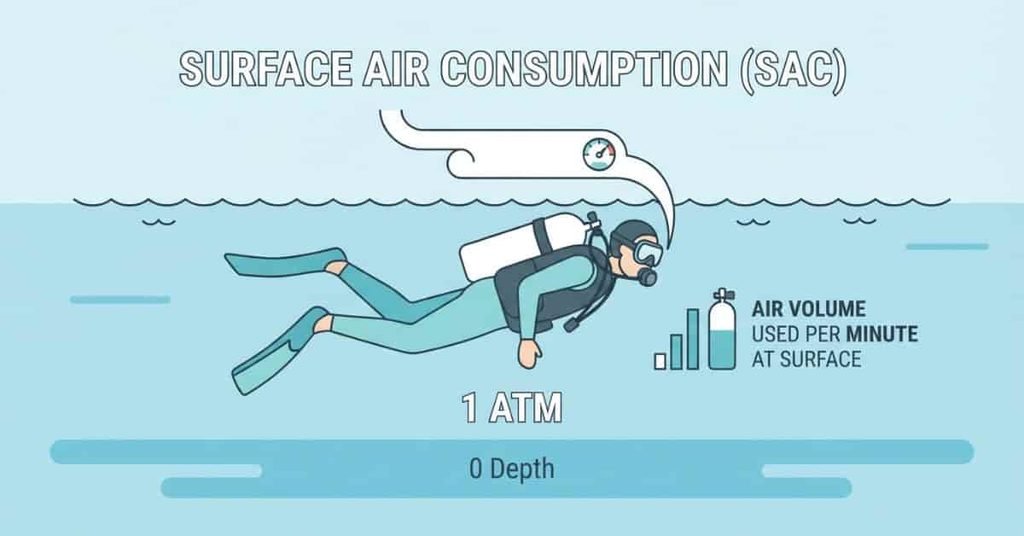
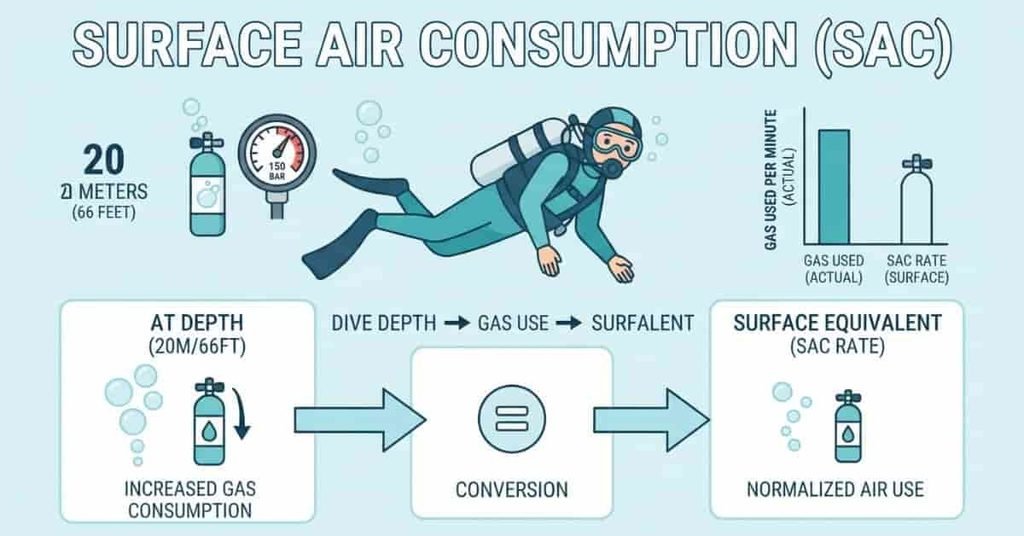
SAC rate, or Surface Air Consumption, estimates how much breathing gas you would use per minute at the surface. It helps divers compare air consumption between dives at different depths.
Depth changes the pressure surrounding your body. This affects the amount of gas you consume from your cylinder. SAC removes the depth effect by converting your measured gas use to a surface-equivalent rate.
Many scuba instructors teach SAC because it gives divers a practical way to understand their breathing habits. Training agencies such as PADI include gas-management skills in recreational diver education. Divers can use SAC when planning gas needs for future dives.
SAC and RMV (Respiratory Minute Volume) describe related concepts, but they aren’t identical. SAC commonly uses cylinder pressure to express surface-normalized consumption. RMV describes the actual volume of breathing gas consumed per minute.
Pro tip: Treat SAC as a planning tool, not a score. A lower rate isn’t automatically better if you sacrifice comfort or safe breathing.
What Is the Average Air Consumption in Scuba Diving?
There isn’t one “normal” air consumption rate for every scuba diver. Your SAC rate depends on your breathing, experience, depth, equipment, and dive conditions.
Beginners often use more gas than experienced divers. New divers may breathe faster because they feel nervous or concentrate heavily on their skills. Buoyancy control can also take extra effort while you’re still learning.
Experienced divers often develop calmer breathing and smoother movement. They may use less gas during similar dives. However, lower air consumption doesn’t automatically mean better diving.
SAC rates can vary widely between individual divers. Rather than chasing a specific number, track your own rate over several dives. Compare dives with similar depths, conditions, and equipment.
Your SAC should help with dive planning and gas management, not become a competition with other divers. Your instructor can also help you understand whether your air use fits your experience and diving conditions.
Expert tip: Focus first on relaxed breathing and good buoyancy. Efficient air consumption usually improves naturally as your comfort and skills develop.
You can calculate your own estimated SAC rate using our scuba air consumption calculator.
Average Air Consumption at 20 Feet
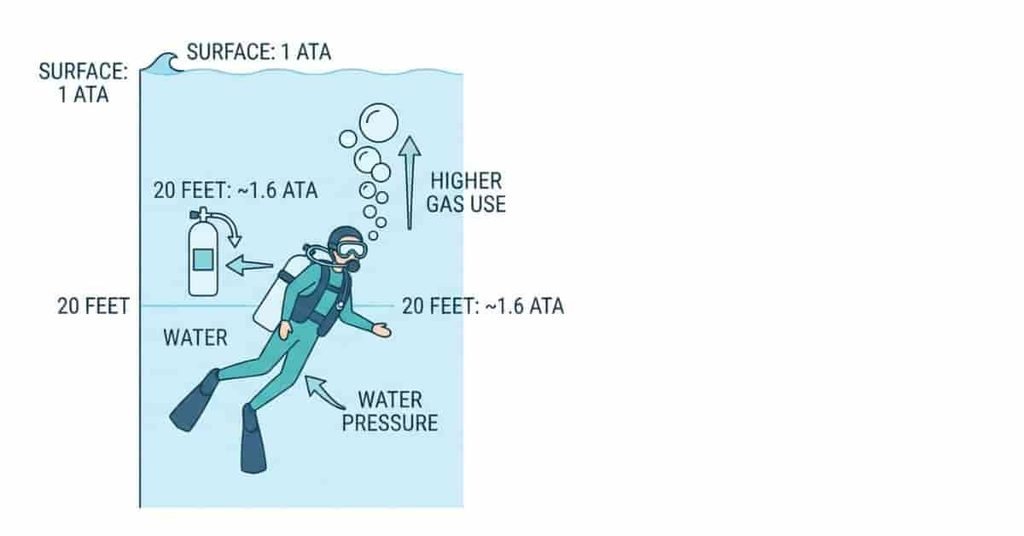
At 20 feet, you use more breathing gas than you would at the surface. The main reason is the increase in surrounding water pressure.
At sea level, surface pressure is about 1 atmosphere. At 20 feet of seawater, the surrounding pressure is roughly 1.6 atmospheres. This means each breath contains more gas molecules than the same-sized breath at the surface.
Your regulator delivers gas at the pressure needed for you to breathe comfortably. However, the cylinder loses gas faster at depth because each breath uses more gas molecules.
For example, imagine taking the same-sized breath at the surface and at 20 feet. The underwater breath contains roughly 1.6 times the gas compared with the surface equivalent.
This doesn’t mean your cylinder pressure drops exactly 1.6 times faster in every situation. Your breathing rate, movement, stress, and equipment also affect consumption.
Understanding this basic depth relationship helps you estimate gas needs more realistically. Even shallow dives can increase gas consumption compared with breathing at the surface.
Pro tip: Always plan your gas supply around the actual depth and dive conditions rather than assuming surface air use stays constant.
Factors That Affect Scuba Air Consumption
Several factors can change how quickly you use gas underwater. Understanding them can help you improve your efficiency without forcing your breathing.
Breathing pattern: Fast or shallow breathing can increase gas use. Calm, steady breathing usually supports better air management.
Stress and anxiety: Nervousness can make you breathe faster. New divers may notice higher consumption during their first few dives. Greater confidence often helps breathing become calmer.
Buoyancy control: Poor buoyancy can make you work harder underwater. Constantly kicking or adjusting your position uses extra energy and can increase breathing demand.
Fitness level: Your overall fitness can affect how hard your body works during a dive. However, fitness alone doesn’t determine your SAC rate.
Water temperature: Cold water can increase your body’s workload. Exposure protection also affects how much energy you need to stay comfortable.
Other factors matter too, including current, swimming speed, equipment configuration, and dive depth. You can’t control every condition, so focus on the factors you can manage.
Your weighting and buoyancy can affect how efficiently you move underwater, so learn how much weight you need for scuba diving.
How to Calculate Scuba Diving Air Consumption
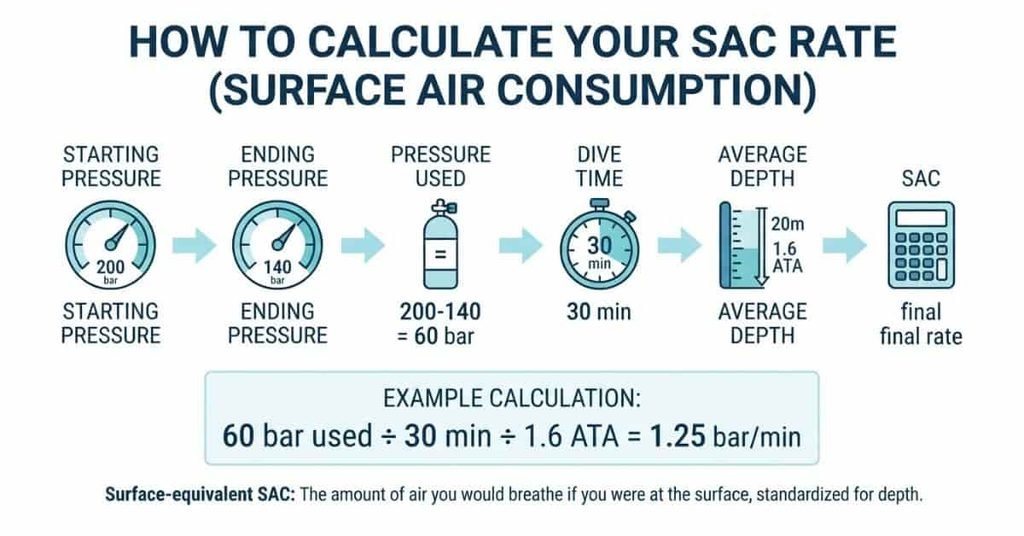
Calculating your scuba air consumption helps you understand how efficiently you use breathing gas. It can also improve your gas planning.
A simple SAC calculation uses your cylinder pressure, dive time, and average depth. You then adjust the result for the surrounding pressure.
A basic pressure-based approach looks like this:
SAC = Pressure Used ÷ Dive Time ÷ Absolute Pressure
For example, suppose you use 60 bar during a 30-minute dive. Your average depth is 20 feet, where pressure is about 1.6 ATA.
Your calculation would be:
60 ÷ 30 ÷ 1.6 = 1.25 bar/min
This gives an estimated surface-equivalent pressure consumption rate. However, pressure-based calculations depend on your cylinder size and measurement units.
For more precise gas-volume calculations, divers can calculate RMV using their cylinder’s internal volume. This approach lets you compare actual gas volume consumption between dives.
You don’t need to calculate SAC during the dive. Record your starting pressure, ending pressure, dive time, and average depth afterward.
Pro tip: Calculate your rate across several dives instead of relying on one result. This gives you a more useful personal baseline.
Is My Air Consumption Normal?
Many beginners wonder if they use too much air underwater. In most cases, higher air consumption during early dives isn’t unusual.
New divers often focus on several skills at once. They may feel nervous, adjust their buoyancy frequently, or kick more than necessary. These factors can increase breathing demand.
Your instructor usually looks at the bigger picture rather than one SAC number. They may consider your depth, dive conditions, experience, breathing pattern, buoyancy, and overall comfort.
You should pay closer attention if your air consumption suddenly changes without an obvious reason. A significant change can sometimes reflect stress, poor buoyancy, equipment issues, or unusual physical effort.
Never try to reduce air consumption by holding your breath or deliberately taking unusually small breaths. Safe breathing should always come first.
Instead, work on relaxed breathing, better buoyancy, and smooth movement. As you gain experience, you may naturally become more efficient underwater.
Expert tip: Ask your instructor to review your air consumption after several dives. They can help identify practical ways to improve your gas management.
Conclusion
Understanding average air consumption in scuba diving helps you plan safer and more comfortable dives. Your SAC rate can change with depth, breathing, stress, buoyancy, fitness, and water temperature.
Beginners often use more air than experienced divers. That doesn’t automatically mean something is wrong. Focus on relaxed breathing, good buoyancy, and smooth underwater movement.
Track your cylinder pressure, dive time, and depth across several dives. This gives you a more useful picture of your personal air consumption. Never hold your breath to conserve gas.
With practice, your confidence and gas management can improve naturally. If you’re unsure about your SAC rate, ask your dive instructor for guidance.
Have you noticed your air consumption changing as you’ve gained experience? Share your experience, and explore more beginner scuba diving guides on our website.
Frequently Asked Questions
There isn’t one ideal SAC rate for every beginner. Air consumption varies with depth, breathing pattern, stress, buoyancy, fitness, water temperature, and equipment. New divers often use more air while building confidence and mastering buoyancy. Instead of chasing a specific number, track your SAC rate across several dives. Compare dives with similar depths and conditions. Your instructor can help you understand whether your air consumption fits your experience and diving environment.
A scuba tank doesn’t have one fixed dive time. Its duration depends on cylinder size, starting pressure, depth, breathing rate, activity level, and water conditions. A diver may use gas faster at depth because surrounding pressure increases. Beginners may also consume more air because of stress or extra movement. The safest approach is to calculate your personal air consumption and plan your dive around your available gas and required reserve.
Beginners often use air quickly because underwater breathing feels unfamiliar. Stress, anxiety, poor buoyancy, frequent kicking, and inefficient movement can increase breathing demand. Depth also increases gas consumption because each breath requires more gas than at the surface. Focus on relaxed breathing, proper weighting, and good buoyancy instead of trying to force a slower breathing rate. Never hold your breath to conserve gas.
It often improves as divers become more comfortable underwater. Experience can lead to better buoyancy, smoother movement, calmer breathing, and less unnecessary effort. However, improvement isn’t guaranteed, and every diver has different air consumption. Conditions also matter. Track your SAC rate across multiple dives instead of comparing yourself with another diver. Your goal should be safe and comfortable gas management, not achieving the lowest possible consumption.
Yes. Water pressure increases as you descend, so each breath contains more gas molecules than an equivalent breath at the surface. At 20 feet of seawater, the surrounding pressure is roughly 1.6 atmospheres. Therefore, you consume more gas at 20 feet than at the surface. Your actual consumption also depends on breathing rate, activity, stress, and other diving conditions.
Start by improving buoyancy and reducing unnecessary movement. Practice calm, steady breathing without holding your breath. Check that your weighting and equipment setup support good trim and comfort. Avoid rushing underwater, especially when completing tasks. Cold water, currents, and stress can also increase gas use. Track your cylinder pressure, dive time, and depth after each dive. Over time, these records can reveal patterns in your personal air consumption.
Not necessarily. Higher air consumption is common during the early stages of scuba training. New divers may feel nervous and spend extra energy controlling buoyancy or position. Your instructor should evaluate your overall diving habits rather than one SAC result. As your confidence and skills improve, your air consumption may become more efficient. Focus on safe breathing and proper gas management rather than trying to match an experienced diver.
You can estimate SAC by recording your starting cylinder pressure, ending pressure, dive time, and average depth. First, calculate how much pressure you used. Then divide that amount by your dive time and adjust it for the absolute pressure at your average depth. Cylinder size matters when converting pressure consumption into actual gas volume. For accurate calculations, use the method taught by your instructor and keep consistent records across several dives.
No. A lower SAC rate doesn’t automatically mean you’re a better diver. Your consumption depends on many personal and environmental factors. Trying to reduce your rate by taking unnaturally small breaths or holding your breath can create unsafe habits. Good diving focuses on relaxed breathing, buoyancy control, awareness, and proper gas planning. A comfortable and predictable SAC rate is more useful than simply chasing the lowest number.

Scuba Diving Researcher & Beginner Guide
Evan Calder is the creator of DiveBeginner, a website dedicated to helping beginners learn scuba diving simply and practically 🌊
He focuses on scuba fundamentals, beginner safety, and clear diving guidance. Evan has studied ocean and marine science through programs at the Scripps Institution of Oceanography, UC San Diego, a globally recognized leader in ocean research.
Instead of complex technical language, Evan provides easy-to-follow, beginner-friendly guides based on real-world research, helping first-time divers feel confident before their first dive 🤿
DiveBeginner reflects his passion for making scuba diving accessible, safe, and enjoyable for everyone.